
Administrator by China Associction for Science and Technology
Sponsored by China Society of Automotive Engineers
Published by AUTO FAN Magazine Co. Ltd.
Sponsored by China Society of Automotive Engineers
Published by AUTO FAN Magazine Co. Ltd.

Automotive Engineering ›› 2022, Vol. 44 ›› Issue (12): 1944-1953.doi: 10.19562/j.chinasae.qcgc.2022.12.016
Special Issue: 车身设计&轻量化&安全专题2022年
Previous Articles Next Articles
Haiyan Li1( ),Hangjie Su1,He Zhu2,Chong Liu2,Yanxin Wang1,Shihai Cui1,Lijuan He1,Yida Wang1,Lü Wenle1
Received:2022-06-13
Revised:2022-07-10
Online:2022-12-25
Published:2022-12-22
Contact:
Haiyan Li
E-mail:lihaiyan@tust.edu.cn
Haiyan Li,Hangjie Su,He Zhu,Chong Liu,Yanxin Wang,Shihai Cui,Lijuan He,Yida Wang,Lü Wenle. The Application of the Injury Bionic Model of Chinese Three-year-old Child Occupant to the Simulation of C-NCAP Frontal Crash Tests[J].Automotive Engineering, 2022, 44(12): 1944-1953.
"

"

"

"
"
"

"
"

"

"
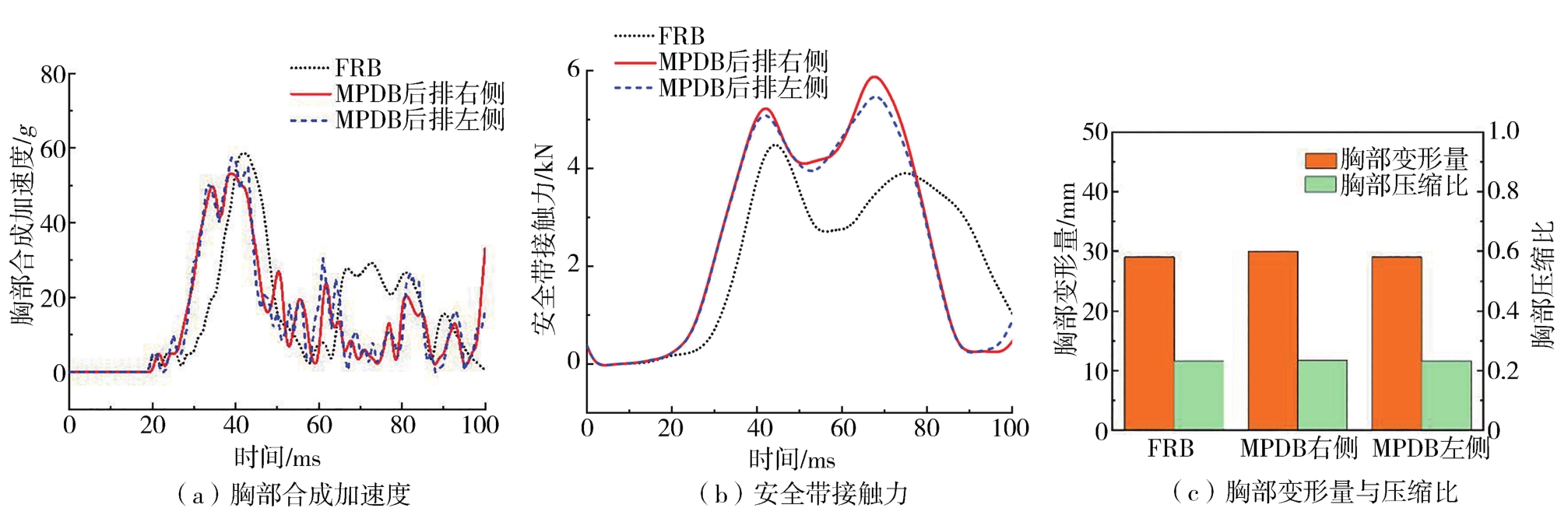
| 响应类型 | 损伤评价指标 | FRB | MPDB 后排右侧 | MPDB 后排左侧 | 阈值 |
|---|---|---|---|---|---|
| 运动学响应 | HIC15 | 257 | 691 | 677 | 高性能限值500 低性能限值700 |
| 头部累积3 ms合成加速度 | 54g | 89g | 79g | 高性能限值60g 低性能限值80g | |
| BrIC | 1.19 | 1.97 | 1.77 | 1,45%概率AIS 4级脑损伤 | |
| 颈部张力 | 435 N | 331 N | 314 N | 高性能限值1 555 N 低性能限值2 840 N | |
| 胸部累积3 ms合成加速度 | 58g | 54g | 58g | 高性能限值41g 低性能限值55g | |
| 胸部最大变形量 | 29 mm | 30 mm | 29 mm | 40 mm | |
| 胸部最大压缩比 | 23.3% | 23.5% | 23.3% | 35% | |
| 生物力学响应 | 脑组织Von Mises应力 | 5 kPa | 8 kPa | 7 kPa | 6-11 kPa,脑挫伤 大于15 kPa,轻微脑震荡 大于38 kPa,重度脑损伤[ |
| 脑组织颅内压 | 184 kPa | 374 kPa | 277 kPa | 大于173 kPa,轻度脑损伤 大于235 kPa,致命脑损伤[ | |
| 脑组织剪切应力 | 6.0 kPa | 8.8 kPa | 8.2 kPa | 6 kPa,25%概率轻度脑损伤 7.8 kPa,50%概率轻度脑损伤 10 kPa,80%概率轻度脑损伤 25 kPa,100%概率中度脑损伤[ | |
| 脑组织最大主应变MPS | 0.34 | 0.41 | 0.42 | 0.45,50%概率轻微脑震荡[ | |
| 肺部第一主应变 | 0.17 | 0.29 | 0.28 | 大于0.35,肺挫伤[ | |
| 心脏第一主应变 | 0.11 | 0.10 | 0.09 | 大于0.3,心脏挫伤[ |
| 1 | World Health Organization. Global status report on road safety 2018:Summary [EB/OL]. WHO,2018. (2020-08-01). |
| 2 | National Highway Traffic Safety Administration. Traffic safety facts 2012[EB/OL]. http// www-fars. nhtsa. dot. gov,2014-03-01. |
| 3 | BERFENSTAM R. Sweden's pioneering child accident programme: 40 years later[J]. Injury Prevention,1995,1(2):68-69. |
| 4 | C-NCAP管理中心. C-NCAP管理规则(2021版)[S]. 天津:中国汽车技术研究中心,2020. |
| C-NCAP Management Center. C-NCAP management regulation(2021 version)[S]. Tianjin:China Automotive Technology and Research Center Co. ,2020 | |
| 5 | 张金换,李志刚,胡敬文,等. 汽车儿童安全保护的欧美法规对比及未来研究方向[J]. 汽车安全与节能学报,2011(3):5-11. |
| ZHANG J H,LI Z G,HU J W,et al. Child passenger safety regulation comparison between Europe and United States and the developing trends[J]. Journal of Automotive Safety and Energy,2011(3):5-11. | |
| 6 | KING A I. 加快中国汽车安全发展的建议[J]. 汽车安全与节能学报,2010,1(1):1-5. |
| KING A I. Suggestion for making rapid advances in automotive safety in China[J]. Journal of Automotive Safety and Energy,2010,1(1):1-5. | |
| 7 | Toyota Motor Corporation. Total human model for safety (THUMS),AM50 pedestrian/occupant model[G]. Academic Version 4. 0_20111003,October 2011. |
| 8 | 李海岩,李琨,黄永强,等. 轿车与6岁儿童行人不同方位碰撞中下肢损伤分析[J]. 汽车工程,2021,43(2):262-268. |
| LI H Y,LI K,HUAGN Y Q,et al. Analysis of lower extremity injury of six-year-old child pedestrian in different orientation collisions with car[J]. Automotive Engineering,2021,43(2):262-268. | |
| 9 | 李海岩,李健,崔世海,等. 儿童安全座椅中填充吸能泡沫对头部的保护效果分析[J]. 汽车工程,2020,42(2): 228-233,269. |
| LI H Y,LI J,CUI S H,et al. Analysis on child-head protection effects of energy-absorbing foam filled in safety seat[J]. Automotive Engineering,2020,42(2):228-233,269. | |
| 10 | 阮世捷,苏航杰,李海岩,等. 正面100%重叠刚性壁障碰撞试验仿真中三岁儿童乘员的损伤评价[J]. 汽车工程,2022,44(3):403-411. |
| RUAN S J,SU H J,LI H Y,et al. Injury assessment of three-year-old child occupant in frontal 100% overlap rigid barrier crash test simulation[J]. Automotive Engineering,2022,44(3):403-411. | |
| 11 | 崔世海,陈越,李海岩,等. 儿童头部有限元模型的构建及验证[J]. 医用生物力学,2015,30(5):452-457. |
| CUI S H,CHEN Y,LI H Y,et al. Development and validation for the finite element model of child head[J]. Journal of Medical Biomechanics,2015,30(5):452-457. | |
| 12 | 杜治青. 三岁儿童颈部有限元模型的构建及损伤分析[D]. 天津:天津科技大学,2016. |
| DU Z Q. Development of a three-year-old child FE neck model and injury analysis[D]. Tianjin:Tianjin University of Science & Technology,2016. | |
| 13 | 梁云飞. 三岁儿童乘员胸部有限元模型的构建及损伤分析[D]. 天津:天津科技大学,2016. |
| LIANG Y F. Development and injury analysis of a three-year-old child occupant thoracic finite element model[D]. Tianjin:Tianjin University of Science & Technology,2016. | |
| 14 | 芦瑞瑞,李海岩. 基于三岁儿童腹部有限元模型的对比仿真研究[C]. China:Proceedings of the 12th International Forum of Automotive Traffic Safety,2015:414-419. |
| LU R R,LI H Y. Comparative simulation study based on finite element model of three-year-old children’s abdomen[C]. China:Proceedings of the 12th International Forum of Automotive Traffic Safety,2015:414-419. | |
| 15 | 贺丽娟,李海岩,朱小菊,等. 基于3岁儿童乘员下肢有限元模型的生长板损伤机理研究[J]. 汽车工程学报,2017,7(3):182-187. |
| HE L J,LI H Y,ZHU X J,et al. Mechanism study of the injured growth plate using a lower extremity finite element model of a 3-year-old occupant[J]. Chinese Journal of Automotive Engineering,2017,7(3):182-187. | |
| 16 | MONTOYA D,THOLLON L,LLARI M,et al. Head injury criteria in child pedestrian accidents[J]. International Journal of Crashworthiness,2018,23(5). |
| 17 | 水野幸治,韩勇,陈一唯. 汽车碰撞安全[M]. 北京:人民交通出版社,2016:18-19. |
| MIZUNO Koji,HAN Yong,CHEN Yiwei. Automobile crash safety[M]. Beijing:China Communications Press,2016:18-19. | |
| 18 | BAUMGARTNER D,WILLINGER R,SHEWCHENKO N,et al. Tolerance limits for mild traumatic brain injury derived from numerical head impact replication[C]. Proc of International IRCOBI Conference on the Biomechanics of Impacts. Isle of Man,UK:IRCOBI,2001:353-355. |
| 19 | WARD C. The development of a detailed finite element brain model[C]. Stapp Car Crash Conference, 1975. |
| 20 | ZHANG L,YANG K H,KING A. A proposed injury threshold for mild traumatic brain injury[J]. Journal of Biomechanical Engineering,2004,126 (2):226-236. |
| 21 | TAKHOUNTS E G,CRAIG M J,MOORHOUSE K,et al. Development of brain injury criteria (BrIC)[J]. Stapp Car Crash Journal,2013,57:243-266. |
| 22 | STITZEL J D,GAYZIK F S,HOTH J J,et al. Development of a finite element-based injury metric for pulmonary contusion part I:model development and validation[J]. Stapp Car Crash Journal,2005,49(49):271-289. |
| 23 | 崔世海,单蕾蕾,李海岩,等. 6岁儿童乘员胸部有限元模型验证及损伤分析[J]. 汽车工程学报,2016,6(6):418-424. |
| CUI S H,SHAN L L,LI H Y,et al. Development and validation of a 6-year-old occupant thorax finite element model and impact injury analysis[J]. Chinese Journal of Automotive Engineering,2016,6(6):418-424. |
| [1] | Yanxin Wang,Haiyan Li,Shihai Cui,Lijuan He,Lü Wenle. Research on Prediction Model and Assessment Parameters of Head Injury for Child Occupants Based on BP Neural Network [J]. Automotive Engineering, 2024, 46(2): 329-336. |
| [2] | Haiyan Li,Jing Hu,Lijuan He,Linghua Ran,Lü Wenle,Shihai Cui,Shijie Ruan. Development and Validation of an Injury Biomimetic Model of 5th Percentile Female Occupant Exhibiting Chinese Anthropometry [J]. Automotive Engineering, 2023, 45(10): 1965-1974. |
| [3] | Hongbin Tang,Junyuan Zhang,Guojun Liu. A Method for Predicting Frontal Crash Grade [J]. Automotive Engineering, 2022, 44(3): 392-398. |
| [4] | Shijie Ruan,Hangjie Su,Haiyan Li,Shihai Cui,Lijuan He,Lü Wenle. Injury Assessment of Three-Year-Old Child Occupant in Frontal 100% Overlap Rigid Barrier Crash Test Simulation [J]. Automotive Engineering, 2022, 44(3): 403-411. |
| [5] | Xiaojie Chen,Song Li. Study on the Slid Mode in Vehicle Small-Overlap Frontal Crash [J]. Automotive Engineering, 2022, 44(10): 1591-1599. |
| [6] | Gang Liu,Liang Hong,Ruhai Ge. Optimal Design of Normally-open Airbag for “Out of Position” Child Occupant [J]. Automotive Engineering, 2022, 44(1): 94-104. |
| [7] | Hequan Wu,Jiafei Zhang,Qifan Ren,Lin Hu. Research on the Response of the Elderly Driver’s Lower Limb Model in Frontal Collisions at Different Angles [J]. Automotive Engineering, 2021, 43(5): 739-745. |
| [8] | Hui Jin,Haotian Li. Alarm Strategy for Frontal Crash Warning System Based on Driving Style [J]. Automotive Engineering, 2021, 43(3): 405-413. |
| [9] | Shihai Cui,Weisheng Ma,Haiyan Li,Lijuan He,Lü Wenle. Finite Element Analysis on Head Injury of Child Occupants in City Bus [J]. Automotive Engineering, 2021, 43(3): 414-420. |
| [10] | Hequan Wu,Jiafei Zhang,Lin Hu. Influence of Seat Rotation Speed on Occupants in Autonomous Driving [J]. Automotive Engineering, 2021, 43(2): 226-231. |
| [11] | Xiangwen Song,Meng Zou,Shucai Xu,Binbing Huang. The Safety Development and Validation of Child Safety Seat Under the Condition of Misuse [J]. Automotive Engineering, 2021, 43(12): 1780-1786. |
| [12] | Haiyan Li,Yanxin Wang,Lijuan He,Lü Wenle,Shihai Cui. Evaluation of Head and Neck Injuries of a Six-year-old Child Occupant with Different Sitting Postures During a MPDB Crash Test [J]. Automotive Engineering, 2021, 43(12): 1793-1799. |
| [13] | Wu Hequan, Peng Jinping, Deng Xiaoshun, Jin Xin, Hu Lin. Research on Chest Response of Elderly Drivers in Frontal Crash [J]. Automotive Engineering, 2020, 42(8): 1050-1059. |
| [14] | Zhang Jian, Zhao Qingjiang, Xu Zuowen, Shi Aimin, Guo Yihui. Research on Wheel Hinge Failure in 25% Small Overlap Frontal Crash [J]. Automotive Engineering, 2020, 42(8): 1066-1073. |
| [15] | Ge Ruhai, Cui Yizhong, Hong Liang, Xiao Xuan. Optimization of Active Safety Airbag for 12-year-old Children [J]. Automotive Engineering, 2020, 42(6): 771-777. |
