

汽车工程 ›› 2025, Vol. 47 ›› Issue (11): 2187-2201.doi: 10.19562/j.chinasae.qcgc.2025.11.013
• • 上一篇
曹婷婷,张海伦( ),袁泉
),袁泉
收稿日期:2025-02-11
修回日期:2025-05-07
出版日期:2025-11-25
发布日期:2025-11-28
通讯作者:
张海伦
E-mail:iszhanghailun@outlook.com
基金资助:
Tingting Cao,Hailun Zhang(),Quan Yuan
Received:2025-02-11
Revised:2025-05-07
Online:2025-11-25
Published:2025-11-28
Contact:
Hailun Zhang
E-mail:iszhanghailun@outlook.com
摘要:
随着智能座舱技术的快速发展,触控交互系统逐渐成为人车交互的核心组成部分,用户体验已成为其设计与优化的重要目标。为提升现有测评体系在交互体验维度的适用性,本文旨在构建一种面向用户体验改善的人机交互界面(human-machine interface, HMI)触控交互测评方法。本文在分析C-SAE、C-ICAP和I-VISTA等典型评估方法的基础上,设计了涵盖视觉协调性、操作合理性、人机便利性、信息易读性、功能完整性和安全性等6个维度的综合评价体系。融合主观用户评价与客观交互性能数据,采用层次分析法进行指标权重设定。通过静态模拟实验与实车动态测试相结合的方法,在中型智能电动车型上开展验证,结果表明所构建方法可有效反映触控交互系统对用户体验的综合影响。研究成果可为智能座舱交互设计、人因工程评价与测评体系优化提供参考依据。
曹婷婷,张海伦,袁泉. 面向用户体验改善的HMI触控交互测评方法[J]. 汽车工程, 2025, 47(11): 2187-2201.
Tingting Cao,Hailun Zhang,Quan Yuan. HMI Touch Interaction Evaluation Method for User Experience Improvement[J]. Automotive Engineering, 2025, 47(11): 2187-2201.
表1
触控交互测评方法对比"
测评 标准 | 一级指标 | 二级指标 | 三级指标 | 评价项 目数量 | 核心评价维度 | 与C-SAE匹配度(触控交互) | 与C-SAE匹配度 (整体智能座舱) |
|---|---|---|---|---|---|---|---|
| C-SAE | 交互能力(30%) | 触控交互(31%) | HMI交互(34%) | 8 | 任务完成时间、视线偏移时间、满意度 | 80% | |
| C-ICAP | 智能交互 (60%) | 触控交互 (40%) | 触屏效果(65%) | 12 | 显示效果、点击响应时长、操作便捷性 | 26% | 80% |
| 操作便捷(30%) | |||||||
| 手机互联(5%) | |||||||
| I-VISA | 语音触屏 (79%) | 触屏交互 (33%) | 可用度(20%) | 15 | 应用启动时间、流畅度、交互安全性 | 26% | 80% |
| 丰富度(5%) | |||||||
| 应用启动时(30%) | |||||||
| 流畅度(20%) | |||||||
| 交互安全度(25%) |
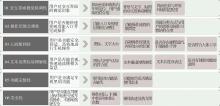
图1
触控交互测评模型的测评维度"
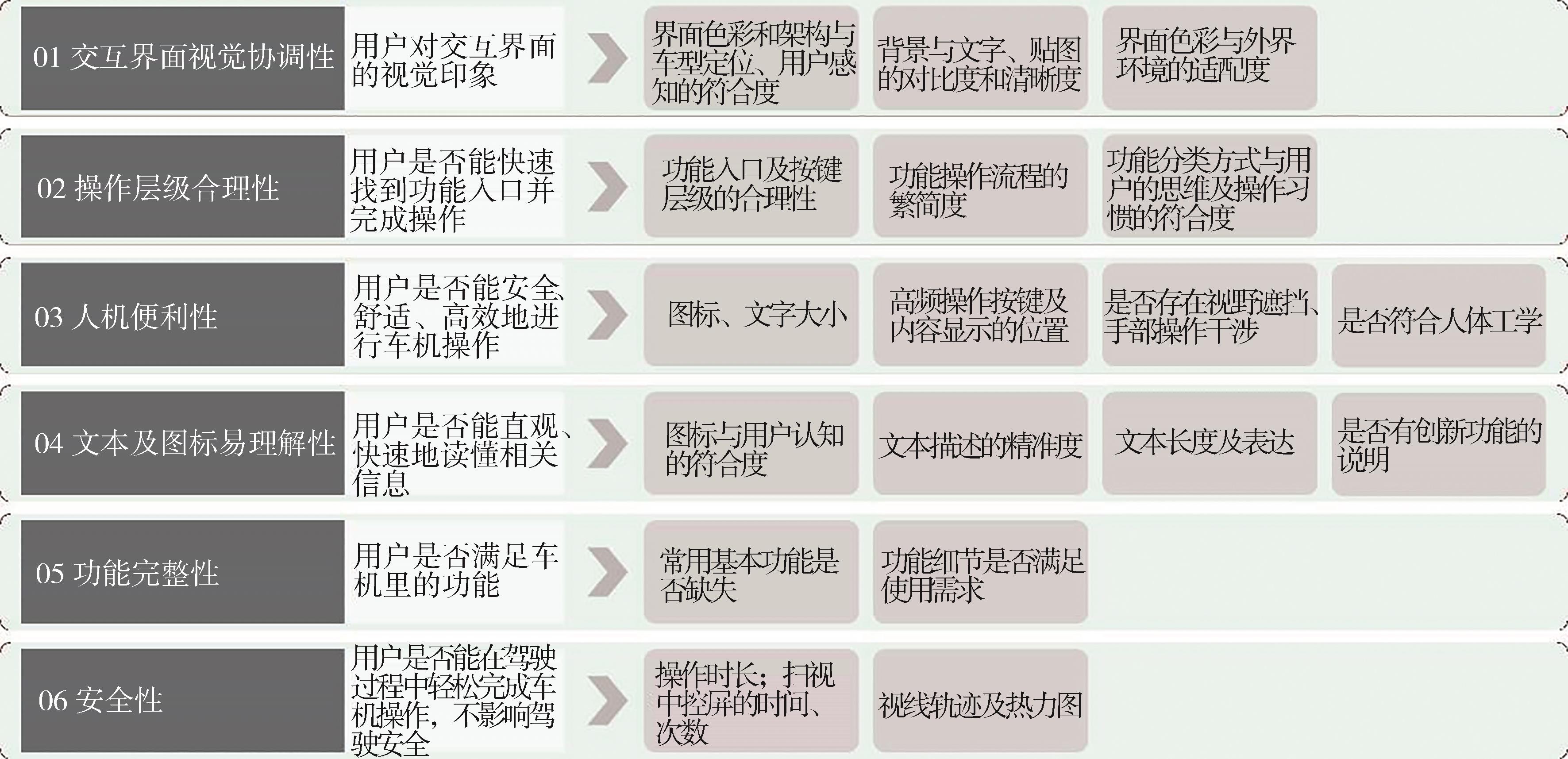
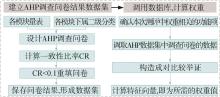
图2
AHP权重计算方法"
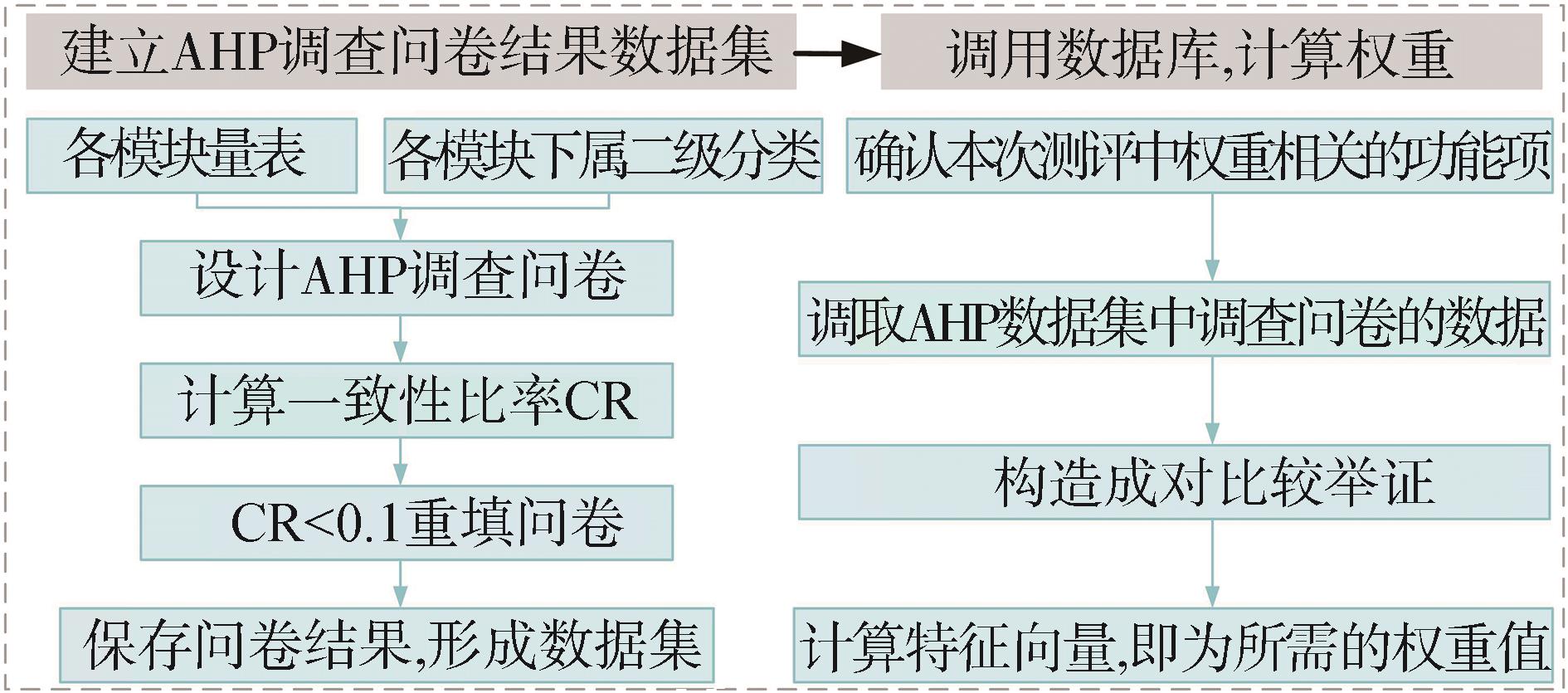
表2
AHP评分系统"
| 非常不重要 | 不重要 | 同等重要 | 重要 | 非常重要 | |
|---|---|---|---|---|---|
| 与交互界面视觉重要性相比,文本及图标易理解性的重要性? | |||||
| 与交互界面视觉重要性相比,人机便利性的重要性? | |||||
| 与交互界面视觉重要性相比,操作层级合理性的重要性? | |||||
| 与交互界面视觉重要性相比,功能完整性的重要性? | |||||
| 与文本及图标易理解性相比,人机便利性的重要性? | |||||
| 与文本及图标易理解性相比,操作层级合理性的重要性? | |||||
| 与文本及图标易理解性相比,功能完整性的重要性? | |||||
| 与人机便利性相比,操作层级合理性的重要性? | |||||
| 与人机便利性相比,功能完整性的重要性? | |||||
| 与操作层级合理性相比,功能完整性的重要性? |
表3
随机一致性RI值"
| n 阶 | 3 | 4 | 5 | 6 | …… |
|---|---|---|---|---|---|
| RI值 | 0.52 | 0.89 | 1.12 | 1.26 | …… |
表4
各维度权重计算结果"
| 排序 | 维度 | 权重 |
|---|---|---|
| 1 | 人机便利性 | 28.42% |
| 2 | 操作层级合理性 | 23.33% |
| 3 | 文本及图标易理解性 | 17.98% |
| 4 | 交互界面视觉协调性 | 17.57% |
| 5 | 功能完整性 | 12.71% |
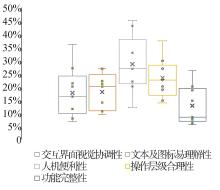
图3
各维度权重计算结果箱线图"
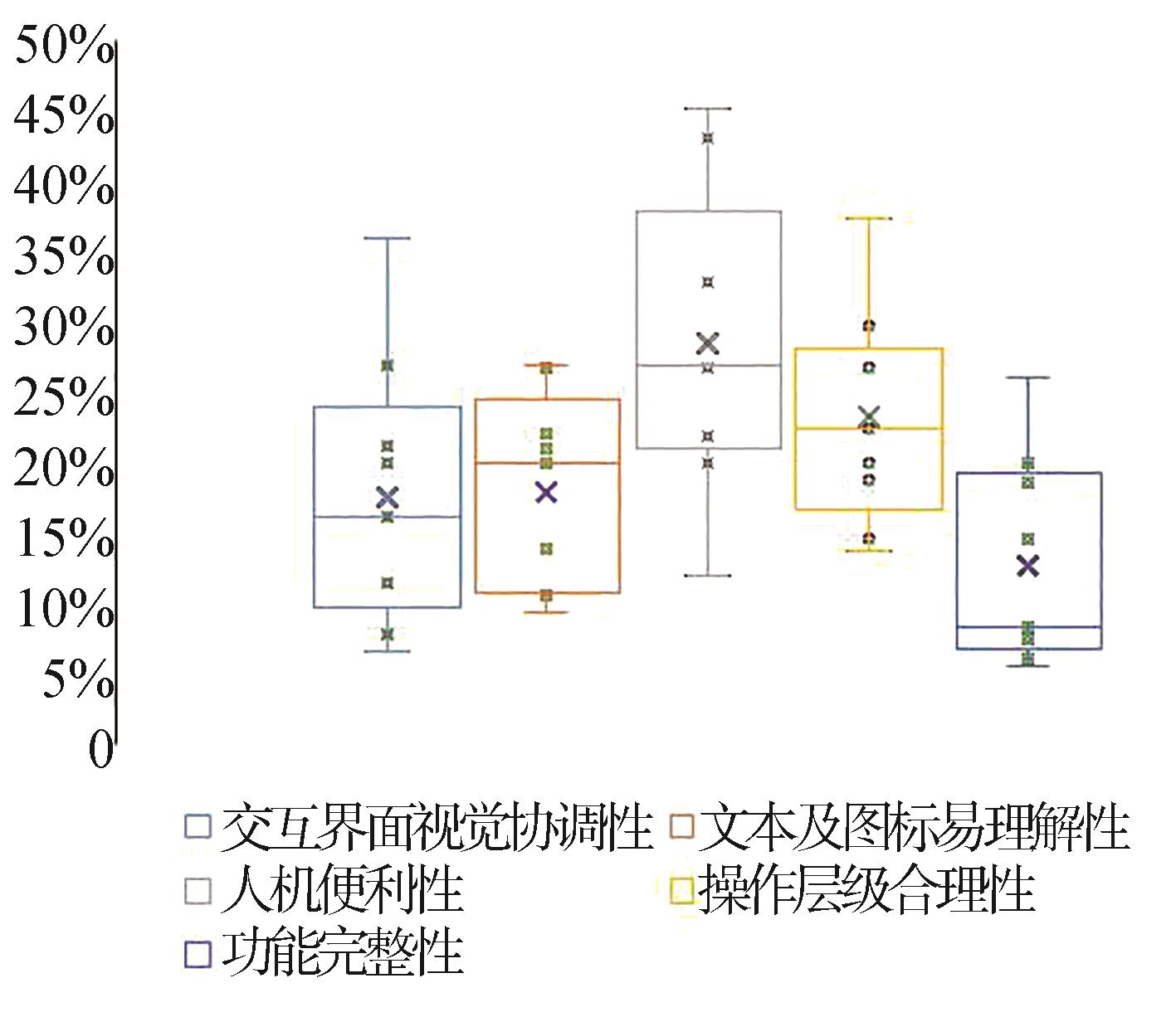
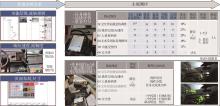
图4
实车测评方法构架"


图5
测评车型信息"


图6
测评设备"
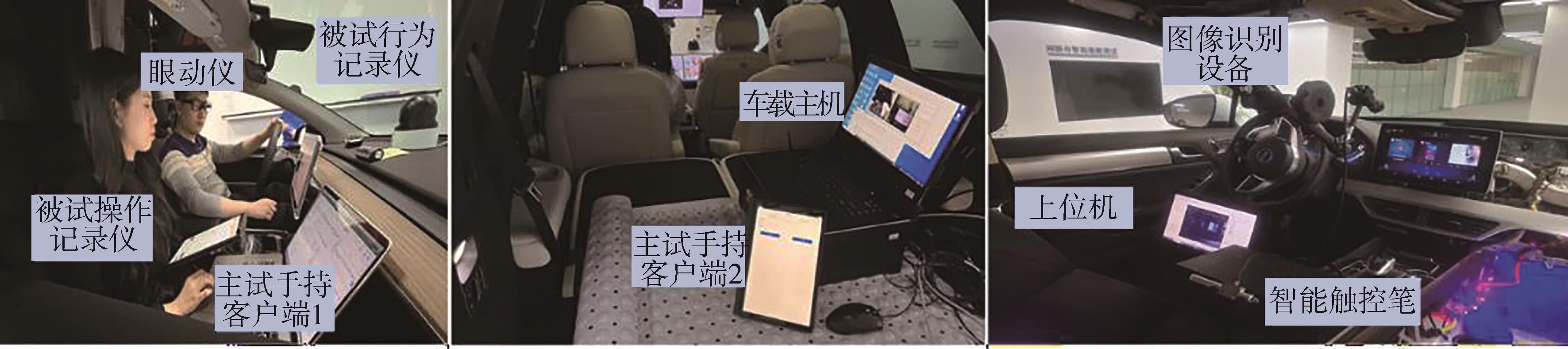
表5
HMI系统的功能数量与层级的比较"
| 项目 | 问界 M7 | 比亚迪SEAL | 小鹏G9 | 理想L9 | 特斯拉MY | |
|---|---|---|---|---|---|---|
空调 模块 | 功能数量 | 36 | 25 | 34 | 37 | 23 |
| 平均层级 | 2.42 | 2.05 | 2.5 | 2.68 | 1.96 | |
导航 模块 | 功能数量 | 54 | 36 | 35 | 37 | 13 |
| 平均层级 | 3.43 | 3.61 | 3.65 | 4.03 | 4.15 | |
通讯 模块 | 功能数量 | 9 | 14 | 9 | 11 | 9 |
| 平均层级 | 3.33 | 3.5 | 3.22 | 2.91 | 3.33 | |
| 多媒体模块 | 功能数量 | 15 | 14 | 14 | 16 | 18 |
| 平均层级 | 2.73 | 2.67 | 2.71 | 2.44 | 3.33 | |
车控 模块 | 功能数量 | 25 | 17 | 22 | 17 | 43 |
| 平均层级 | 3.9 | 4.06 | 4.45 | 3.67 | 3.12 | |
表6
响应流畅度测评内容"
| 类别 | 数量 | 测试内容 |
|---|---|---|
| 应用启动完成时延-冷启动 | 10 | 爱奇艺;哔哩哔哩;网易云;打开行车记录仪;打开设置;打开广播;打开蓝牙电话;打开导航地图;…… |
| 应用启动完成时延-热启动 | 10 | 爱奇艺;哔哩哔哩;打开行车记录仪;打开设置;打开广播;打开蓝牙电话;打开导航地图;…… |
| 通话操作响应时长 | 3 | 拨打电话;挂断电话;接听电话; |
| 图操作响应时长 | 4 | 导航内点击搜索;点击开始导航(市外地名);点击开始导航(市内地名);放大导航地图 |
| 多媒体控制响应时长 | 7 | 切换音乐主界面Tab;切换下一首歌曲;切换热门歌手;退出音乐界面;退出音乐界面;切换下一广播电台;…… |
| 车辆操作响应时长 | 8 | 打开空调界面;关闭空调界面;打开全景泊车…… |
| 蓝牙操作响应时长 | 5 | 打开蓝牙界面-下拉菜单;打开蓝牙界面-车辆设置界面;已配对手机连接蓝牙…… |
| 方控响应时长 | 3 | 方控切换下一首歌曲;方控接听电话;方控挂断电话 |
| 流畅度 | 4 | 通话记录界面滑动流畅度;通讯录界面滑动流畅度;菜单滑动流畅度;空调界面滑动流畅度 |
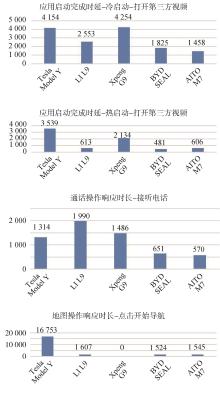
图7
响应性试验测试结果"

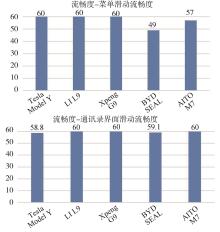
图8
流畅度试验测试结果"
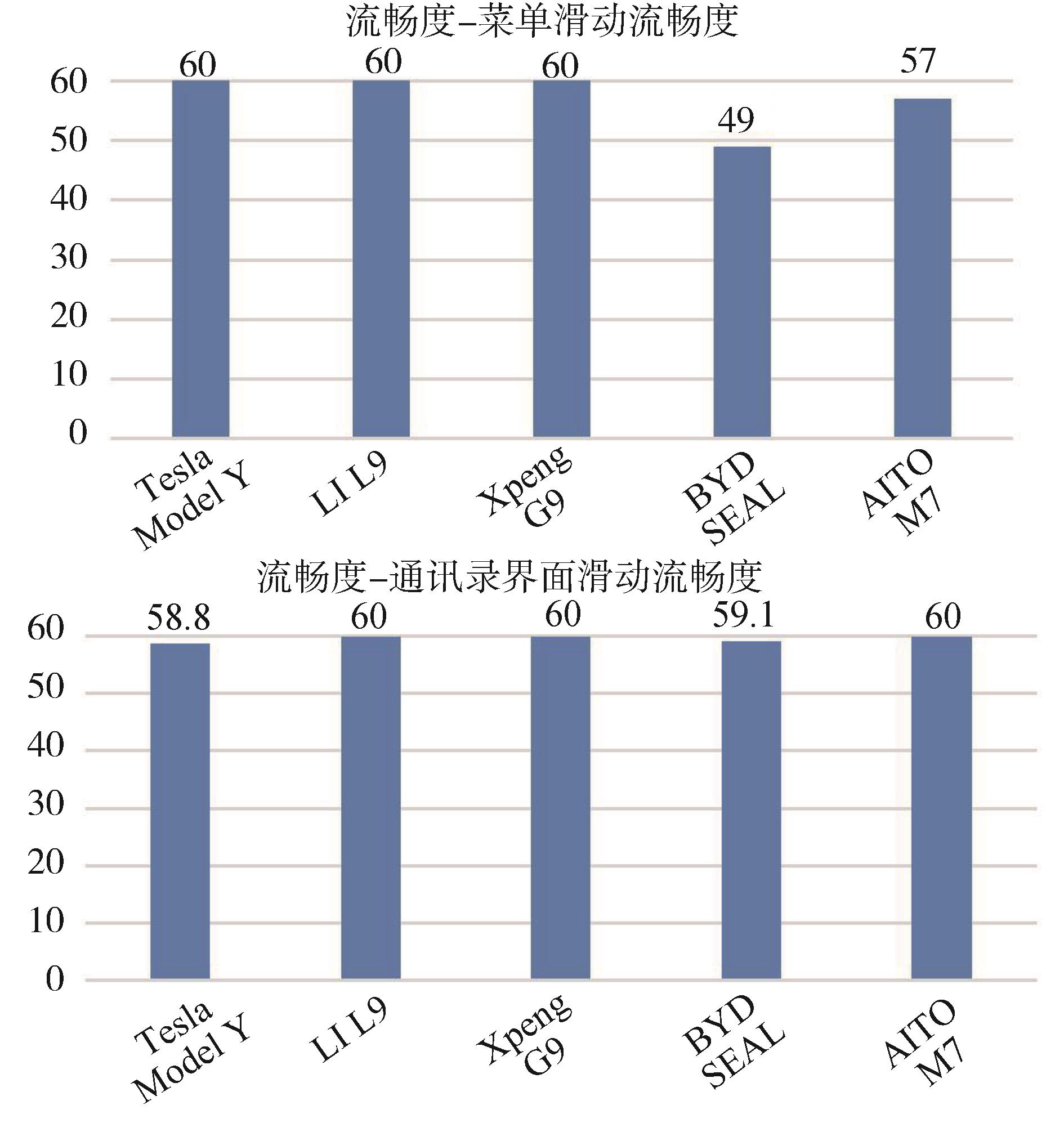
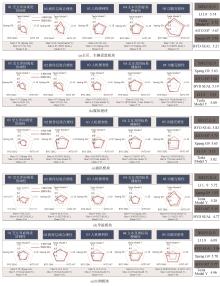
图9
各模块主观测评结果"

表7
触控交互安全性测评结果汇总"
| 测评指标 | 均值 | 标准差 | 高风险占比 | 备注 | 说明 |
|---|---|---|---|---|---|
| 视线离路时间 | 1.85 s | 0.42 s | 13% | 单次离路>2 s为高风险 | 部分多级菜单切换任务超2 s |
| 总离路比例 | 36.7% | 8.2% | 占总触控时间比例 | 导航、车辆设置模块最高 | |
| 单次操作持续时间 | 4.8 s | 1.3 s | 每个触控任务完成时间 | 空调、导航操作时间最长 | |
| 眼动热区分布 | 屏幕46.2%,前方道路38.5% | 视线集中区域分布 | 屏幕关注比例大于道路 |
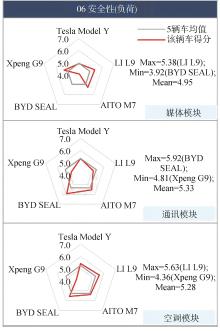
图10
安全性主观测评结果"

表8
主客观测评结果Spearman相关性分析"
| 功能模块 | 主观维度 | 客观指标 | 相关系数 | 显著性水平p |
|---|---|---|---|---|
| 主页/车辆设置 | 便利性 | 任务完成时间 | -0.63 | 0.014 |
| 媒体模块 | 流畅度 | 平均帧率 | 0.58 | 0.027 |
| 通讯模块 | 易用性 | 最大离路时间 | -0.52 | 0.041 |
| 导航模块 | 理解性 | 启动时延 | -0.66 | 0.009 |
| 空调模块 | 合理性 | 操作步数 | -0.49 | 0.048 |
表9
大众ID.7改善前后测试结果对比"
| 版本 | 主页/车辆设置模块 | 媒体模块 | 通讯模块 | 导航模块 | 空调模块 | 总分 |
|---|---|---|---|---|---|---|
| ID OS1.0 | 4.32 | 5.20 | 5.48 | 4.86 | 5.14 | 5.05 |
| ID OS2.0 | 4.61 | 5.22 | 5.52 | 4.91 | 5.16 | 5.09 |
| [1] | RITTGER L, ENGELHARDT D, SCHWARTZ R. Adaptive user experience in the car—levels of adaptivity and adaptive HMI design[J]. IEEE Transactions on Intelligent Transportation Systems, 2022, 23(5): 4866-4876. |
| [2] | HUO F, ZHAO Y, CHAI C, et al. A user experience map design method based on emotional quantification of in-vehicle HMI[J]. Humanities and Social Sciences Communications, 2023, 10(1): 1-10. |
| [3] | LI B, WANG X, WU Y, et al. Research on driver KSS rating prediction model based on EU 2021/1341 DDAW[C]. 2023 International Conference on Artificial Intelligence and Automation Control (AIAC). IEEE, 2023: 195-201. |
| [4] | 全国汽车标准化技术委员会(SAC/TC 114). 驾驶员注意力监测系统性能要求及试验方法: GB/T 41797—2022[S]. 北京: 中国标准出版社, 2022. |
| National Technical Committee for Standardization of Automobiles (SAC/TC 114). Performance requirements and test methods for driver attention monitoring systems: GB/T 41797—2022[S]. Beijing: China Standards Press, 2022. | |
| [5] | 全国汽车标准化技术委员会(SAC/TC 114). 汽车全景影像监测系统性能要求及试验方法: GB/T 44176—2024[S]. 北京: 中国标准出版社, 2024. |
| National Technical Committee for Standardization of Automobiles (SAC/TC 114). Performance requirements and test methods for automobile panoramic image monitoring systems: GB/T 44176—2024[S]. Beijing: China Standards Press, 2024. | |
| [6] | 中国汽车技术研究中心有限公司. 中国智能网联汽车技术规程: 智慧座舱测评规则[R]. 天津: 中国汽车技术研究中心有限公司, 2023. |
| China Automotive Technology and Research Center Co., Ltd. China intelligent connected vehicle technical specifications: smart cockpit evaluation rules[R]. Tianjin: China Automotive Technology and Research Center Co., Ltd., 2023. | |
| [7] | 中国汽车工程学会. 汽车智能座舱智能化水平测试与评价方法: T/BJQC 202301—2023[S]. 北京: 中国汽车工程学会, 2023. |
| SAE-China. Test and evaluation method for intelligent level of automobile intelligent cockpit: T/BJQC 202301—2023[S]. Beijing: SAE-China, 2023. | |
| [8] | 中国汽车工程研究院股份有限公司. 中国智能汽车指数管理办法[R]. 重庆: 中国汽车工程研究院股份有限公司, 2023. |
| China Automotive Engineering Research Institute Co., Ltd. China intelligent vehicle index management measures[R]. Chongqing: China Automotive Engineering Research Institute Co., Ltd., 2023. | |
| [9] | 智能交通系统产业技术创新战略联盟. 汽车智能座舱触控交互安全测试评价规程: T/ITS 0221—2023[S]. 北京: 智能交通系统产业技术创新战略联盟, 2023. |
| Intelligent Transportation System Industry Technology Innovation Strategic Alliance. Automobile intelligent cockpit touch interaction safety test evaluation procedure: T/ITS 0221—2023[S]. Beijing: Intelligent Transportation System Industry Technology Innovation Strategic Alliance, 2023. | |
| [10] | Tesla Inc. Tesla Model Y owner's manual: touchscreen interface update report[R/OL]. (2023-01-15)[2025-04-29]. https://www.tesla.com/ownersmanual/modely/en_us/. |
| [11] | 何佳杰. 基于多指标的不同类型汽车HMI界面用户体验评估比较研究[D]. 杭州:浙江理工大学, 2018. |
| HE J J. Comparative research on user experience interface based on evaluation of different types of vehicle HMI interface based on multiple indicators [D]. Hangzhou: Zhejiang Sci-Tech University, 2018. | |
| [12] | LI W, CAO D, TAN R, et al. Intelligent cockpit for intelligent connected vehicles: definition, taxonomy, technology and evaluation[J]. IEEE Transactions on Intelligent Vehicles, 2023, 9(2): 3140-3153. |
| [13] | NAGY V, KOVÁCS G, FÖLDESI P, et al. Testing road vehicle user interfaces concerning the driver’s cognitive load[J]. Infrastructures, 2023, 8(3): 49. |
| [14] | 刘文龙. 基于触控交互和视觉交互的汽车HMI中控屏位置评价研究[D]. 长春: 吉林大学, 2023. |
| LIU W L. Research on position evaluation of automobile HMI central control screen based on touch interaction and visual interaction[D]. Changchun: Jilin University, 2023. | |
| [15] | WANG S M, ZHANG Q P, ZHAO S, et al. Research on the test and evaluation system for the convenience of touch interactive operation under dynamic scenarios[C]. 2024 International Conference on Electronics and Devices, Computational Science (ICEDCS). IEEE, 2024: 1237-1242. |
| [16] | 王畅, 王一飞, 葛振振, 等. 全触屏人机交互模式下驾驶人视觉负荷与操作特性[J]. 汽车安全与节能学报, 2023, 14(4): 431-438. |
| WANG C, WANG Y F, GE Z Z, et al. Driver visual load and operating characteristics under a human-machine interface mode with full-touch-screen [J]. Journal of Automotive Safety and Energy, 2023, 14(4): 431-438. | |
| [17] | HEIMGÄRTNER R. Development of an assessment model for the human centered design processes specified in ISO 9241-220[C].Human-Computer Interaction. Design and User Experience: Thematic Area, HCI 2020, Held as Part of the 22nd International Conference, HCII 2020, Copenhagen, Denmark, July 19–24, 2020, Proceedings, Part I 22. Springer International Publishing, 2020: 50-70. |
| [18] | 胡林, 谷子逸, 王丹琦, 等.汽车安全性测评规程现状及趋势展望[J]. 汽车工程, 2024, 46(2): 187-200,240. |
| HU L, GU Z, WANG D, et al. Current status and trend of automotive safety procedures/programs [J]. Automotive Engineering, 2024, 46(2): 187-200,240. | |
| [19] | LARGE D R, BURNETT G, CRUNDALL E, et al. Twist it, touch it, push it, swipe it: evaluating secondary input devices for use with an automotive touchscreen HMI[C]. Proceedings of the 8th International Conference on Automotive User Interfaces and Interactive Vehicular Applications, 2016: 161-168. |
| [20] | GAO F, GE X, LI J, et al. Intelligent cockpits for connected vehicles: Taxonomy, architecture, interaction technologies, and future directions[J]. Sensors, 2024, 24(16): 5172. |
| [21] | 王亚辉. 智能汽车座舱人机交互认知机制与评价方法研究[D]. 西安: 西北工业大学, 2019. |
| WANG Y H. Cognitive mechanism and evaluation method of human-machine interaction in intelligent vehicle cockpit [D]. Xi’an: Northwestern Polytechnical University, 2019. | |
| [22] | 郁淑聪, 孟健, 郝斌. 基于驾驶员的智能座舱人机工效测评研究[J]. 汽车工程, 2022, 44 (1): 36-43. |
| YU S C, MENG J, HAO B. Research on ergonomic evaluation of driver-based intelligent cabin[J]. Automotive Engineering, 2022, 44 (1): 36-43. | |
| [23] | 戴文雅.基于设计心理学的共享汽车中控屏界面设计研究[D]. 哈尔滨: 东北林业大学, 2022. |
| DAI W Y. Research on the interface design of shared car central control screen based on design psychology[D]. Harbin: Northeast Forestry University, 2022. | |
| [24] | 陈晓华. 基于用户体验的汽车智能中控HMI设计研究[D]. 上海: 上海交通大学, 2020. |
| CHEN X H. Research on the design of automotive intelligent central control HMI based on user experience[D]. Shanghai: Shanghai Jiaotong University, 2020. | |
| [25] | YANG J, WAN Q, HAN J, et al. An evaluation model for automobile intelligent cockpit comfort based on improved combination weighting-cloud model[J]. Plos one, 2023, 18(3): e0282602. |
| [26] | VAIDYA O S, KUMAR S. Analytic hierarchy process: an overview of applications[J]. European Journal of Operational Research, 2006, 169(1): 1-29. |
| [27] | 李飞, 李文强, 李彦. 基于双层关联的用户需求重要度计算与转换方法[J]. 计算机集成制造系统, 2018, 24(11): 2836-2845. |
| LI F, LI W, LI Y. Weight calculation and transformation method of customer requirements based on double layer association[J]. Computer Integrated Manufacturing Systems, 2018, 24(11): 2836-2845. | |
| [28] | 中华人民共和国交通运输部. 公路工程技术标准: JTG B01—2014[S]. 北京: 人民交通出版社股份有限公司, 2015. |
| Ministry of Transport of the People's Republic of China. Highway engineering technical standard: JTG B01—2014[S]. Beijing: People's Communications Press Co., Ltd., 2015. | |
| [29] | 中建标公路委员会. 公路沥青路面设计规范: JTG D50—2017[S]. 北京: 人民交通出版社, 2022. |
| China Construction Standard Highway Committee. Highway asphalt pavement design specification: JTG D50—2017[S]. Beijing: People's Communications Press, 2022. | |
| [30] | KRAUSE M, DONANT N, BENGLER K. Comparing occlusion method by display blanking to occlusion goggles[J]. Procedia Manufacturing, 2015, 3: 2650-2657. |
| [31] | JOSHI S, BLOCK A, SCHMITT P. Autonomous vehicle and external road user interfaces: mapping of standards gaps and opportunities[C]. Adjunct Proceedings of the 15th International Conference on Automotive User Interfaces and Interactive Vehicular Applications, 2023: 30-35. |
| [32] | STOJMENOVA K, POLICARDI F, SODNIK J. On the selection of stimulus for the auditory variant of the detection response task method for driving experiments[J]. Traffic Injury Prevention, 2018, 19(1): 23-27. |
| [33] | 王映霓. 基于用户体验的新能源汽车人机交互界面设计研究[D] . 成都: 四川师范大学, 2022. |
| WANG Y X. Research on human-machine interface design of new energy vehicles based on user experience[D]. Chengdu: Sichuan Normal University, 2022. | |
| [34] | 闫鹏.基于移动端的疲劳驾驶监测应用的设计与实现[D]. 武汉: 华中科技大学, 2022. |
| YAN P. Design and implementation of fatigue driving monitoring application based on mobile device[D]. Wuhan: Huazhong University of Science and Technology, 2022. |
| [1] | 罗玉涛,郭丰瑞. 基于注意力融合特征增强的座舱表情识别模型[J]. 汽车工程, 2024, 46(9): 1697-1706. |
| [2] | 陈国强,申正义,孙利,支梦帆,李彤. 基于BP神经网络优化遗传算法的智能座舱感性意象预测[J]. 汽车工程, 2023, 45(8): 1479-1488. |
| [3] | 郁淑聪,孟健,郝斌. 基于驾驶员的智能座舱人机工效测评研究[J]. 汽车工程, 2022, 44(1): 36-43. |
|
||
