

汽车工程 ›› 2025, Vol. 47 ›› Issue (11): 2113-2125.doi: 10.19562/j.chinasae.qcgc.2025.11.006
• • 上一篇
刘朱紫1,李银2,李奇奇2,胡林2,邹铁方2( )
)
收稿日期:2025-01-04
修回日期:2025-05-15
出版日期:2025-11-25
发布日期:2025-11-28
通讯作者:
邹铁方
E-mail:tiefang@163.com
基金资助:
Zhuzi Liu1,Yin Li2,Qiqi Li2,Lin Hu2,Tiefang Zou2()
Received:2025-01-04
Revised:2025-05-15
Online:2025-11-25
Published:2025-11-28
Contact:
Tiefang Zou
E-mail:tiefang@163.com
摘要:
飞行汽车(eVTOL)的使用意愿受多种因素影响,目前关于结构安全与共情对使用意愿的作用研究仍有限。本研究基于技术接受模型(TAM),提出包含潜变量“结构安全”的飞行汽车使用意愿框架,并通过问卷调查收集760份数据,经信效度检验后,建立不同共情群体的技术接受模型。结果表明,共情水平显著影响用户对飞行汽车的感知与接受程度,且不同共情群体在使用意愿、感知有用、结构安全等潜变量上存在极显著差异,导致模型框架完全不同。所有模型均显示,感知有用对态度有显著正向影响,结构安全通过提升感知有用间接影响态度;分析表明,感知有用须通过实际应用验证,结构安全须在轻量化与安全之间协调,并加强碰撞测试规程的制定。研究结果从技术与情感两个维度拓展了TAM理论,将为eVTOL的安全设计及差异化推广提供跨学科支持。
刘朱紫,李银,李奇奇,胡林,邹铁方. 结构安全与共情差异对飞行汽车使用意愿的影响研究[J]. 汽车工程, 2025, 47(11): 2113-2125.
Zhuzi Liu,Yin Li,Qiqi Li,Lin Hu,Tiefang Zou. Study on the Impact of Structural Safety and Empathy Differences on the Willingness to Use eVTOLs[J]. Automotive Engineering, 2025, 47(11): 2113-2125.
表1
技术接受模型测量项来源及问卷效度分析结果"
| 潜变量 | 测量项 | 因子载荷系数 | 测量项 来源 | ||||||
|---|---|---|---|---|---|---|---|---|---|
| 因子1 | 因子2 | 因子3 | 因子4 | 因子5 | 因子6 | 因子7 | |||
| 使用意愿 | 我希望在飞行汽车上市时使用它 | 0.754 | 0.204 | 0.206 | 0.097 | 0.204 | 0.281 | 0.093 | 文献[ |
| 我计划在飞行汽车上市时使用它 | 0.868 | 0.135 | 0.137 | 0.030 | 0.172 | 0.188 | 0.237 | ||
| 我打算在飞行汽车上市时使用它 | 0.864 | 0.138 | 0.135 | 0.018 | 0.213 | 0.174 | 0.214 | ||
| 结构安全 | 飞行汽车的结构越坚固,越安全 | 0.191 | 0.832 | 0.247 | 0.104 | 0.231 | 0.141 | 0.151 | 自主研发 |
| 飞行汽车的结构越坚固,越能保护好乘员 | 0.174 | 0.840 | 0.263 | 0.114 | 0.198 | 0.157 | 0.118 | ||
| 飞行汽车的结构越坚固,越能保护好电池 | 0.121 | 0.839 | 0.259 | 0.092 | 0.192 | 0.165 | 0.182 | ||
| 感知有用 | 我认为飞行汽车将有助于减少交通拥堵 | 0.136 | 0.269 | 0.755 | 0.150 | 0.160 | 0.239 | 0.232 | 文献[ |
| 我认为飞行汽车将有助于减少出行时间 | 0.192 | 0.247 | 0.796 | 0.143 | 0.174 | 0.253 | 0.129 | ||
| 我认为飞行汽车将有助于享受空中观景 | 0.163 | 0.292 | 0.807 | 0.150 | 0.183 | 0.134 | 0.074 | ||
| 感知风险 | 我担心飞行汽车的故障将我置于危险中 | 0.028 | 0.086 | 0.069 | 0.923 | -0.020 | 0.055 | 0.005 | 文献[ |
| 我担心飞行汽车的故障会导致事故 | 0.026 | 0.065 | 0.118 | 0.930 | -0.018 | 0.025 | 0.035 | ||
| 总之,我担心飞行汽车的安全性 | 0.046 | 0.066 | 0.108 | 0.920 | 0.018 | 0.003 | -0.002 | ||
| 初始信任 | 我认为飞行汽车是可靠的 | 0.280 | 0.257 | 0.267 | -0.033 | 0.728 | 0.213 | 0.275 | 文献[ |
| 我认为飞行汽车是值得信赖的 | 0.275 | 0.283 | 0.206 | 0.016 | 0.728 | 0.294 | 0.250 | ||
| 总之,我想我可以相信飞行汽车 | 0.296 | 0.352 | 0.213 | -0.055 | 0.702 | 0.258 | 0.245 | ||
| 态度 | 我认为使用飞行汽车是明智的选择 | 0.376 | 0.210 | 0.216 | 0.045 | 0.285 | 0.734 | 0.165 | 文献[ |
| 我认为使用飞行汽车是个好主意 | 0.303 | 0.223 | 0.348 | 0.053 | 0.271 | 0.705 | 0.186 | ||
| 我认为使用飞行汽车是令人愉快的 | 0.322 | 0.221 | 0.403 | 0.049 | 0.252 | 0.643 | 0.233 | ||
| 感知易用 | 我相信学习使用飞行汽车对我来说很容易 | 0.288 | 0.215 | 0.202 | 0.017 | 0.289 | 0.178 | 0.787 | 文献[ |
| 我相信如果我使用飞行汽车,对我而言会很简单 | 0.294 | 0.222 | 0.183 | 0.022 | 0.268 | 0.200 | 0.793 | ||
| 特征根值(旋转后) | 2.983 | 2.925 | 2.726 | 2.683 | 2.262 | 2.078 | 1.821 | ||
| 方差解释率(旋转后) | 14.914% | 14.625% | 13.632% | 13.417% | 11.311% | 10.392% | 9.107% | ||
| 累积方差解释率(旋转后) | 14.914% | 29.538% | 43.170% | 56.587% | 67.898% | 78.290% | 87.397% | ||
| KMO值 | 0.929 | ||||||||
表2
不同接触场景下的飞行汽车风险认知差异"
不分接触场景 (n=752) | 乘坐空中出租车上下班(n=170) | 乘坐飞行汽车观光旅游(n=230) | 传统出行与居家生活(n=101) | 应用飞行汽车开展救援(n=181) | 飞行汽车送货上门服务(n=70) | 排序 |
|---|---|---|---|---|---|---|
| 坠落安全 | 坠落安全 | 极端天气 | 坠落安全 | 坠落安全 | 坠落安全 | 1 |
| 极端天气 | 极端天气 | 坠落安全 | 环境污染 | 极端天气 | 极端天气 | 2 |
| 信息安全 | 信息安全 | 环境污染 | 信息安全 | 信息安全 | 信息安全 | 3 |
| 环境污染 | 噪声污染 | 信息安全 | 极端天气 | 电池安全 | 环境污染 | 4 |
| 电池安全 | 隐私泄露 | 噪声污染 | 噪声污染 | 环境污染 | 隐私泄露 | 5 |
| 噪声污染 | 环境污染 | 隐私泄露 | 隐私泄露 | 隐私泄露 | 电池安全 | 6 |
| 隐私泄露 | 电池安全 | 电池安全 | 电池安全 | 交通运行 | 噪声污染 | 7 |
| 交通运行 | 交通运行 | 交通运行 | 交通运行 | 噪声污染 | 交通运行 | 8 |
表3
不同共情群体下的飞行汽车接受度差异"
| 项目 | 低共情(n=351) | 高共情(n=409) | p |
|---|---|---|---|
| 结构安全 | 3.000(3.0,3.3) | 4.000(3.0,4.0) | 0.000** |
| 共情能力 | 3.000(3.0,3.4) | 4.200(4.0,4.8) | 0.000** |
| 初始信任 | 3.000(3.0,3.0) | 3.000(3.0,4.0) | 0.000** |
| 感知有用 | 3.000(3.0,4.0) | 4.000(3.3,4.3) | 0.000** |
| 感知易用 | 3.000(3.0,3.0) | 3.000(3.0,4.0) | 0.000** |
| 态度 | 3.000(3.0,3.3) | 3.667(3.0,4.0) | 0.000** |
| 使用意愿 | 3.000(3.0,3.0) | 3.000(3.0,4.0) | 0.000** |
| 感知风险 | 3.000(3.0,4.0) | 4.000(3.0,4.5) | 0.000** |
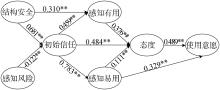
图1
高共情群体飞行汽车接受模型"
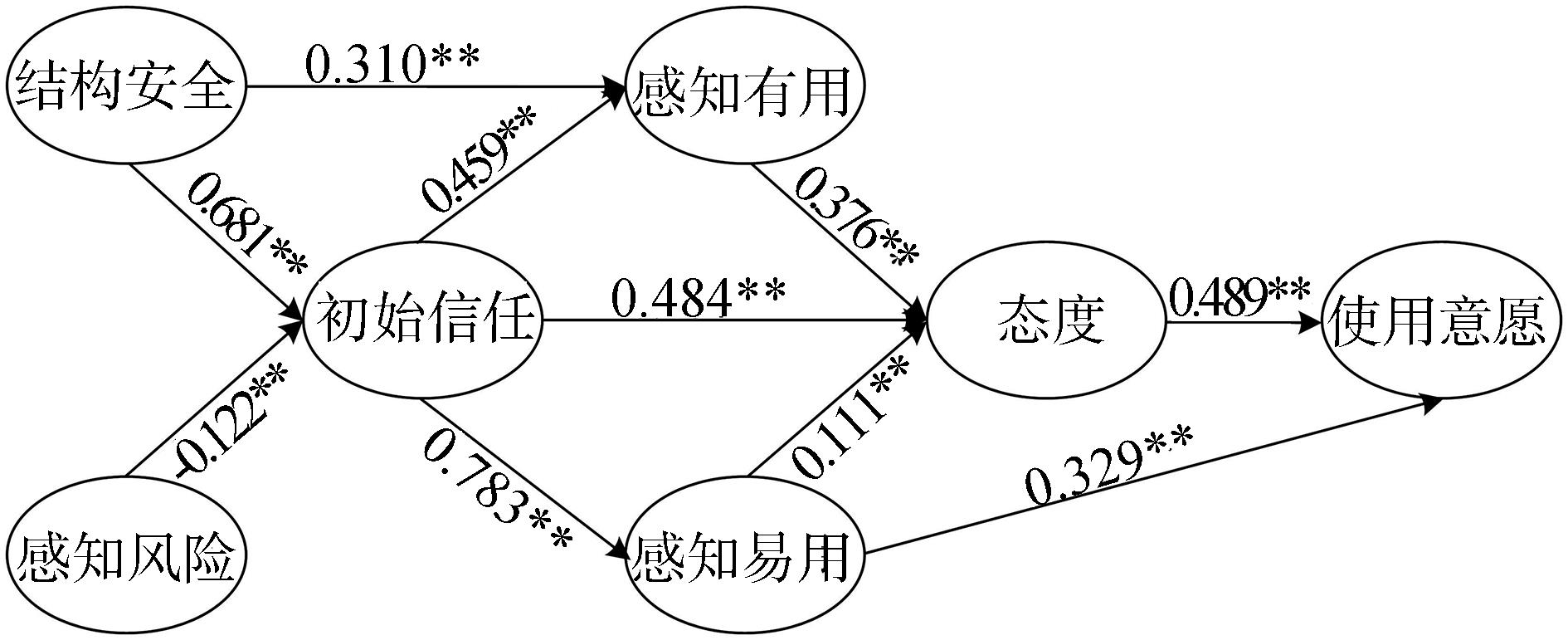
表4
高共情群体飞行汽车接受模型拟合指标"
常用 指标 | 卡方自由度比χ2/df | GFI | RMSEA | RMR | CFI | NFI | NNFI |
|---|---|---|---|---|---|---|---|
判断 标准 | <3,很好 | >0.9 | <0.10 | <0.05 | >0.9 | >0.9 | >0.9 |
| 数值 | 1.812 | 0.937 | 0.045 | 0.029 | 0.984 | 0.965 | 0.981 |
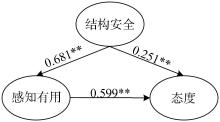
图2
低共情群体飞行汽车接受模型"
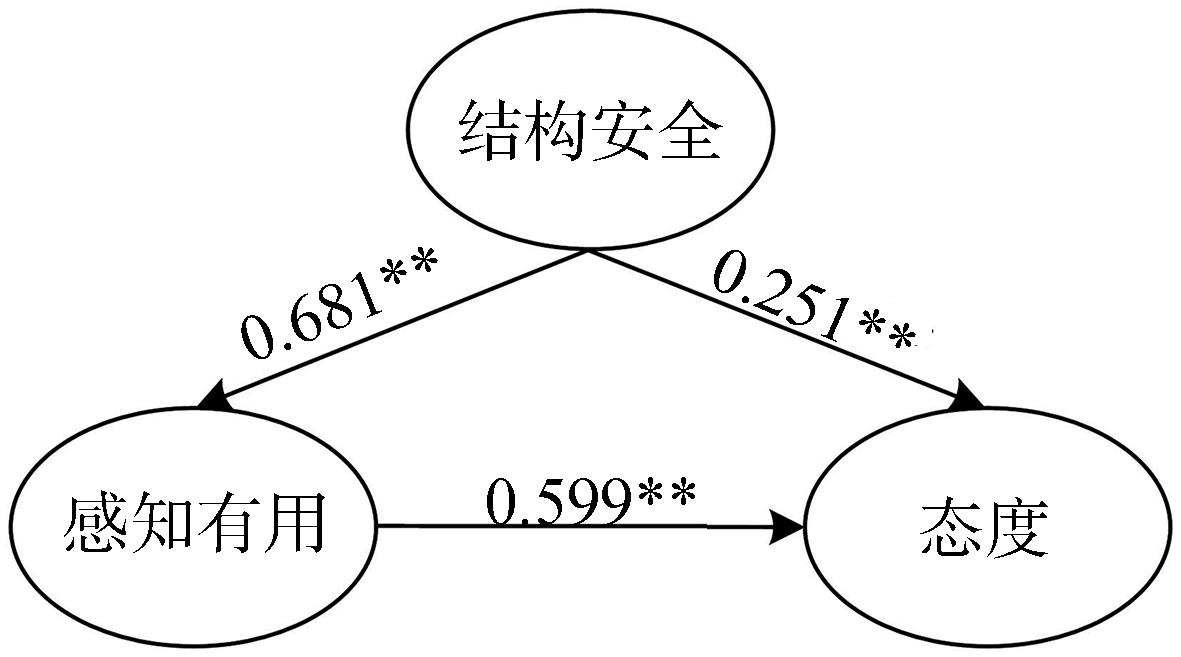
表5
低共情群体飞行汽车使用意愿模型拟合指标"
常用 指标 | 卡方自由度比χ2/df | GFI | RMSEA | RMR | CFI | NFI | NNFI |
|---|---|---|---|---|---|---|---|
判断 标准 | <5,可接受 | >0.9 | <0.10 | <0.05 | >0.9 | >0.9 | >0.9 |
| 数值 | 3.418 | 0.950 | 0.083 | 0.018 | 0.976 | 0.967 | 0.964 |
图3
高/低共情群体飞行汽车接受模型"
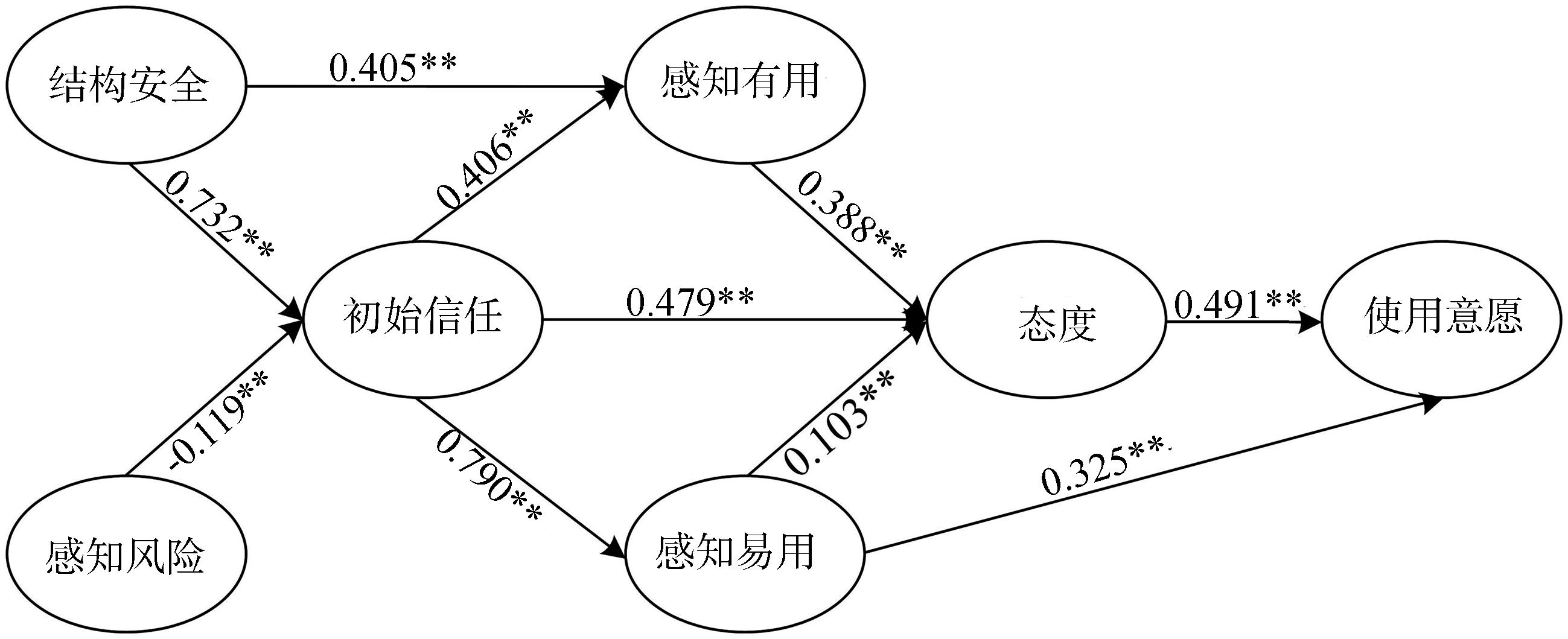
表6
高/低共情群体飞行汽车接受模型拟合指标"
常用 指标 | 卡方自由度比χ2/df | GFI | RMSEA | RMR | CFI | NFI | NNFI |
|---|---|---|---|---|---|---|---|
判断 标准 | <5,可接受 | >0.9 | <0.10 | <0.05 | >0.9 | >0.9 | >0.9 |
| 数值 | 3.002 | 0.941 | 0.051 | 0.029 | 0.978 | 0.968 | 0.974 |
表7
感知风险测量项来源及问卷效度结果"
| 感知风险 | 名称 | 因子载荷系数 | ||||
|---|---|---|---|---|---|---|
| 因子1 | 因子2 | 因子3 | 因子4 | 因子5 | ||
极端天气 环境污染 | 我担心恶劣天气会对飞行汽车产生严重威胁 | 0.768 | 0.239 | 0.281 | 0.287 | 0.257 |
| 我担心飞行汽车在极端天气环境中的安全性问题 | 0.799 | 0.273 | 0.259 | 0.218 | 0.246 | |
| 我担心飞行汽车难以应对复杂的天气情况 | 0.792 | 0.263 | 0.287 | 0.310 | 0.210 | |
| 我担心飞行汽车会压缩鸟类的生存空间 | 0.789 | 0.268 | 0.307 | 0.221 | 0.176 | |
| 我担心飞行汽车会恶化鸟类的生存环境 | 0.796 | 0.249 | 0.302 | 0.253 | 0.222 | |
| 我担心飞行汽车会威胁野生动物,导致城市鸟类数量减少 | 0.768 | 0.203 | 0.338 | 0.262 | 0.241 | |
| 电池安全 | 我担心飞行汽车的电池安全水平 | 0.281 | 0.777 | 0.241 | 0.310 | 0.180 |
| 我担心电池管理系统难以保证电池安全 | 0.269 | 0.810 | 0.238 | 0.306 | 0.211 | |
| 我担心电池管理系统难以确保飞行汽车安全着陆 | 0.276 | 0.828 | 0.216 | 0.180 | 0.235 | |
| 噪声污染 | 飞行汽车飞行时,会加剧城市的噪声污染 | 0.347 | 0.244 | 0.796 | 0.181 | 0.260 |
| 飞行汽车飞行时,会产生噪声而扰民 | 0.375 | 0.250 | 0.792 | 0.226 | 0.235 | |
| 飞行汽车飞行时,会使城市变得吵闹不堪 | 0.387 | 0.243 | 0.780 | 0.174 | 0.202 | |
| 坠落安全 | 我担心飞行汽车坠落地面时,飞行汽车会伤害到地面的行人 | 0.352 | 0.348 | 0.187 | 0.750 | 0.254 |
| 我担心飞行汽车坠落地面引发电池爆炸等严重事故 | 0.429 | 0.356 | 0.217 | 0.687 | 0.268 | |
| 我担心飞行汽车坠落地面时,飞行汽车会伤害到地面的车辆 | 0.377 | 0.334 | 0.279 | 0.720 | 0.273 | |
| 交通运行 | 大量飞行汽车在空中飞行时,我担心它们之间会发生碰撞 | 0.378 | 0.334 | 0.311 | 0.315 | 0.677 |
| 大量飞行汽车在空中飞行时,我担心会发生空中交通拥堵 | 0.321 | 0.286 | 0.330 | 0.327 | 0.715 | |
| 大量飞行汽车在空中飞行时,我担心空中交通管理会变得极为困难 | 0.444 | 0.331 | 0.352 | 0.264 | 0.608 | |
| 特征根值(旋转后) | 5.234 | 3.165 | 3.049 | 2.573 | 2.154 | |
| 方差解释率(旋转后) | 29.077% | 17.584% | 16.940% | 14.293% | 11.968% | |
| 累积方差解释率(旋转后) | 29.077% | 46.661% | 63.601% | 77.894% | 89.862% | |
| KMO值 | 0.947 | |||||
| p 值 | 0.000 | |||||
表8
C-NCAP历年乘员和行人保护得分"
| 测评年份 | 乘员保护平均得分 | 行人保护平均得分 |
|---|---|---|
| 2024年(19辆) | 91.65% | 74.67% |
| 2023年(16辆) | 91.95% | 73.38% |
| 2022年(15辆) | 84.16% | 72.13% |
| 2021年(32辆) | 91.28% | 72.49% |
| 2020年(26辆) | 91.42% | 72.38% |
| 2019年(30辆) | 88.53% | 70.39% |
| 2018年(14辆) | 81.89% | 65.45% |
| [1] | 张新钰, 荣松松, 李骏, 等. 智能飞行汽车关键技术及发展趋势[J]. 中国科学: 技术科学, 2024, 54(4): 601-624. |
| ZHANG Xinyu, RONG Songsong, LI Jun, et al. State-of-the-art and technical trends of intelligent flying cars [J]. Scientia Sinica(Technologica), 2024, 54(4): 601-624. | |
| [2] | 刘文学, 侯聪, 杨亚联, 等. 面向城市空中交通的电动飞行汽车关键性能指标分析[J/OL]. 机械工程学报: .http: //kns.cnki.net/kcms/detail/11.2187.TH.20240229.0854.002.html,1-19 [2024-12-30]. |
| LIU Wenxue, HOU Cong, YANG Yalian, et al. Analysis of key performance metrics of electric flying cars for urban air mobility [J/OL]. Journal of Mechanical Engineering: http: //kns.cnki.net/kcms/detail/11.2187.TH.20240229.0854.002.html,1-19 [2024-12-30]. | |
| [3] | 李颖, 王荣煊, 万成麟, 等. 分体式飞行汽车立体环境感知系统设计及试验研究[J]. 机械工程学报, 2024, 60(10): 102-111. |
| LI Ying, WANG Rongxuan, WAN Chenglin, et al. Design and experiment research of 3D environmental perception system for split-type flying vehicle[J]. Journal of Mechanical Engineering, 2024, 60(10): 102-111. | |
| [4] | 王芳, 白傑, 杨丽平, 等. 探索飞行汽车通勤新模式的城市空中交通发展分析[J]. 北京理工大学学报, 2023, 43(7): 665-675. |
| WANG Fang, BAI Jie, YANG Liping, et al. An overview on development of urban air traffic with a new mode of flying car commuting [J]. Transactions of Beijing Institute of Technology, 2023, 43(7): 665-675. | |
| [5] | UPHAM P, OLTRA C, BOSO A. Towards a cross-paradigmatic framework of the social acceptance of energy systems[J]. Energy Research & Social Science, 2015, 8: 100-112. |
| [6] | WÜSTENHAGEN R, WOLSINK M, BÜRER M J. Social acceptance of renewable energy innovation: an introduction to the concept[J]. Energy Policy, 2007, 35(5): 2683-2691. |
| [7] | ROBIN K, TOBIAS B, LILIANN F. Drones for parcel and passenger transportation: a literature review - science direct[J].Transportation Research Interdisciplinary Perspectives, 2020,4. |
| [8] | 赵传林, 靳思缘, 武海娟, 等.自动代客泊车接受度及停车选择行为影响因素分析[J]. 科学技术与工程,2023,23(35): 15259-15268. |
| ZHAO Chuanlin, JIN Siyuan, WU Haijuan, et al. Influence factors of automated valet parking acceptance and parking choice behavior [J]. Science Technology and Engineering, 2023, 23(35): 15259-15268. | |
| [9] | 刘志伟, 刘建荣. 数字鸿沟背景下老年人对自动驾驶汽车接受度[J]. 交通运输系统工程与信息, 2023, 23(2): 168-175. |
| LIU Zhiwei, LIU Jianrong. Elderly's acceptance of autonomous vehicles in context of digital divide [J]. Journal of Transportation Systems Engineering and Information Technology, 2023, 23(2): 168-175. | |
| [10] | 霍治方, 刘刚, 樊正德. 中国公众对新兴技术采纳的影响机理研究——基于自动驾驶汽车社会实验调查的微观证据[J/OL]. 科学学研:https: //doi.org/10.16192/j.cnki.1003-2053.20240723.001,1-20 [2024-12-31]. |
| HUO Zhifang, LIU Gang, FAN Zhengde. Research on the influence mechanism of the Chinese public on the adoption of emerging technologies -- based on the social experimental survey of self-driving cars micro evidence of investigation [J/OL]. Studies in Science of Science: https: //doi.org/10.16192/j.cnki.1003-2053.20240723.001, 1-20 [2024-12-31]. | |
| [11] | Al HADDAD C, CHANIOTAKIS E, STRAUBINGER A, et al.Factors affecting the adoption and use of urban air mobility[J].Transportation Research Part A: Policy and Practice, 2020, 132. |
| [12] | DAVIS F D, BAGOZZI R P, WARSHAW P R. User acceptance of computer technology: a comparison of twotheoretical models[J]. Management Science, 1989, 35(8): 982-1003. |
| [13] | SUO Y, LI C, TANG L, et al. Exploring AAM acceptance in tourism: environmental consciousness's influence on hedonic motivation and intention to use[J]. Sustainability, 2024, 16(8): 3324. |
| [14] | KARAMI H, ABBASI M, SAMADZAD M, et al. Unraveling behavioral factors influencing the adoption of urban air mobility from the end user's perspective in Tehran - a developing country outlook[J]. Transport Policy, 2024, 145: 74-84. |
| [15] | YAO E, GUO D, LIU S,et al.The role of technology belief, perceived risk and initial trust in users' acceptance of urban air mobility: an empirical case in China[J].Multimodal Transportation, 2024, 3(4). |
| [16] | KWON H, KIM J, PARK Y. Applying LSA text mining technique in envisioning social impacts of emerging technologies: the case of drone technology[J]. Technovation, 2017, 60-61: 15-28. |
| [17] | YAMIN L, CAUCHARD J. Generative adversarial networks and data clustering for likable drone design[J]. Sensors, 2022, 22(17): 6433. |
| [18] | WANG N, MUTZNER N, BLANCHET K.Societal acceptance of urban drones: a scoping literature review[J].Technology in Society, 2023, 75(Nov.): 1.1-1.21. |
| [19] | EASA. Study on the societal acceptance of urban air mobility in Europe[EB/OL]. https: //www.easa.europa.eu/en/full-report-study-societal-acceptance-urban-air-mobility-europe.2021. |
| [20] | AYDIN B. Public acceptance of drones: knowledge, attitudes, and practice[J]. Technology in Society, 2019, 59: 101180. |
| [21] | ZHANG Y, KAMARGIANNI M. A review on the factors influencing the adoption of new mobility technologies and services: autonomous vehicle, drone, micromobility and mobility as a service[J]. Transport Reviews, 2022, 42(2): 234-259. |
| [22] | KELLERMANN R, FISCHER L. Drones for parcel and passenger transport: a qualitative exploration of public acceptance[J]. Tecnociencia, 2020, 10(2): 106-138. |
| [23] | TAN L K, LIM B C, PARK G, et al. Public acceptance of drone applications in a highly urbanized environment[J]. Technology in Society, 2021, 64: 101462. |
| [24] | WANG N. "Killing two birds with one stone”? a case study of development use of drones[C]. 2020 IEEE International Symposium on Technology and Society (ISTAS), 2020: 339-345. |
| [25] | GARZIA F, BORGHINI F, CASTAGNOLO A, et al. Emotional analysis of safeness and risk perception of drones during the COVID-19 pandemic in Italy[C]. 2021 International Carnahan Conference on Security Technology (ICCST), 2021. |
| [26] | CHEN C, LEON S, RACTHAM P. Will customers adopt last-mile drone delivery services? an analysis of drone delivery in the emerging market economy[J]. Cogent Business & Management, 2022, 9(1): 2074340. |
| [27] | 褚华东,胡凤培,王宇航,等.个体共情能力对不同道德行为取向自动驾驶汽车接受意愿的影响[J].应用心理学,2024,30(3): 203-210. |
| CHU Huadong, HU Fengpei, WANG Yuhang, et al. The influence of individual empathy ability on the willingness to accept self-driving cars with different moral behavior orientations [J]. Chinese Journal of Applied Psychology, 2024, 30(3): 203-210. | |
| [28] | PELAU C, DABIJA D C, ENE I. What makes an AI device human-like? the role of interaction quality, empathy and perceived psychological anthropomorphic characteristics in the acceptance of artificial intelligence in the service industry[J]. Journal of Service Research, 2021, 38(7): 24-32. |
| [29] | WANG N, TIAN H, ZHU S, et al. Analysis of public acceptance of electric vehicle charging scheduling based on the technology acceptance model[J]. Energy, 2022, 258: 124804. |
| [30] | 涂然,薛杉,蒋思雨,等.基于技术接受模型的生态驾驶诱导辅助系统认知接受度[J].同济大学学报(自然科学版),2024,52(4): 592-603. |
| TU Ran, XUE SHAN, JIANG Siyu, et al. Drivers' acceptance of eco-driving guidance assistance system based on technology acceptance model [J]. Journal of Tongji University(Natural Science), 2024, 52(4): 592-603. | |
| [31] | 曾超, 褚家亮, 王嵩, 等. 基于TAM-CPV模型的共享电单车持续使用意愿分析[J]. 重庆交通大学学报(自然科学版), 2024, 43(6): 64-70. |
| ZENG Chao, CHU Jialiang, WANG Song, et al. Willingness to continue using shared electric bicycle based on TAM-CPV model[J]. Journal of Chongqing Jiaotong University(Natural Science), 2024, 43(6): 64-70. | |
| [32] | YOUSAFZAI S Y, FOXALL G R, PALLISTER J G. Technology acceptance: a meta-analysis of the TAM: part 1[J]. Journal of Modelling in Management, 2007, 2(3): 251-280. |
| [33] | 邹铁方, 李艳春, 刘朱紫, 等. 基于车辆运动控制的人地碰撞损伤防护新技术接受度研究[J]. 铁道科学与工程学报, 2022, 19(12): 3806-3817. |
| ZOU Tiefang, LI Yanchun, LIU Zhuzi, et al. Study on the acceptance of new technology for protecting pedestrian-ground contact injury based on vehicle motion control [J]. Journal of Railway Science and Engineering, 2022, 19(12): 3806-3817. | |
| [34] | 李振龙, 邢冠仰, 李佳, 等. 基于扩展TAM的车路协同系统驾驶人接受度研究[J]. 中国公路学报, 2021, 34(7): 188-200. |
| LI Zhenlong, XING Guanyang, LI Jia, et al. Dricer’s acceptance of cooperative vehicle infrastructure system based on extended TAM[J]. China Journal of Highway and Transport, 2021, 34(7): 188-200. | |
| [35] | ZHANG T, TAO D, QU X, et al. The roles of initial trust and perceived risk in public’s acceptance of automated vehicles [J]. Transportation Research Part C: Emerging Technologies, 2019, 98: 207-220. |
| [36] | YUEN K F, MA F, WANG X, et al. The role of trust in influencing consumers’ adoption of automated vehicles: an application of the health belief model[J]. International Journal of Sustainable Transportation, 2021, 15(11): 837-849. |
| [37] | ZHANG T, TAO D, QU X, et al. Automated vehicle acceptance in China: social influence and initial trust are key determinants[J]. Transportation Research Part C: Emerging Technologies, 2020, 112: 220-233. |
| [38] | 章锡俏, 毛伟, 洛玉乐, 等. 车路协同系统接受度建模及性别差异分析[J]. 中国公路学报, 2021, 34(7): 177-187. |
| ZHANG Xiqiao, MAO Wei, LUO Yule, et al. Modeling and gender difference analysis of acceptance of cooperative vehicle infrastructure system [J]. China Journal of Highway and Transport, 2021, 34(7): 177-187. | |
| [39] | HOFF K A, BASHIR M.Trust in automation: integrating empirical evidence on factors that influence trust[J].Human Factors The Journal of the Human Factors and Ergonomics Society, 2015, 57(3): 407-434. |
| [40] | 景鹏, 王伟, 吴麟麟. 老年人对自动驾驶汽车接受度研究[J]. 中国公路学报, 2021, 34(6): 158-171. |
| JING Peng, WANG Wei, WU Linlin. Acceptance of autonomous vehicles for the Elderly [J]. China Journal of Highway and Transport, 2021, 34(6): 158-171. | |
| [41] | 马剑, 张艺, 刘杨, 等. 考虑恐高心理的磁浮列车乘客疏散模型与分析[J]. 安全与环境学报, 2020, 20(5): 1822-1828. |
| MA Jian, ZHANG Yi, LIU Yang, et al. Passenger evacuation model and analysis of maglev train considering fear of height psychology [J]. Journal of Safety and Environment, 2020, 20(5): 1822-1828. | |
| [42] | 张艺, 马剑, 罗倩, 等. 走行高度对疏散人员运动特征影响研究[J]. 中国安全科学学报, 2020, 30(4): 135-140. |
| ZHANG Yi, MA Jian, LUO Qian, et al. Influence of walking height on motion features of evacuees [J]. China Safety Science Journal, 2020, 30(4): 135-140. | |
| [43] | 吴营杰. 虚拟现实场景下的人体运动姿态分析[D]. 杭州: 杭州电子科技大学, 2022. |
| WU Yingjie. Analysis of human motion posture in virtual reality [D]. Hangzhou: Hangzhou Dianzi University, 2022. | |
| [44] | NAN Z, ZACHARY P, JUNG L,et al.Virtual reality exercise for anxiety and depression: a preliminary review of current research in an emerging field[J].J Clin Med, 2018, 7(3): 42. |
| [45] | 俞洋钊, 何炳蔚, 白丽英, 等. 基于虚拟现实和动态加权决策融合的恐高情绪识别[J]. 计算机系统应用, 2023, 32(7): 35-46. |
| YU Yangzhao, HE Bingwei, BAI Liying, et al. Fear of heights emotion recognition based on virtual reality and dynamic weighted decision fusion [J]. Computer Systems & Application, 2023, 32(7): 35-46. | |
| [46] | 王凡. 多伦多共情问卷(TEQ)在大学生中的修订与初步应用[D]. 贵阳: 贵州师范大学, 2019. |
| WANG Fan. The revision of toronto empathy questionnaire and preliminary application in college students [D]. Guiyang : Guizhou Normal University, 2019. | |
| [47] | WISPÉ L. History of the concept of empathy[C]//EISENBERG N, STRAYER J, et al. Empathy and its development. New York: Cambridge University Press, 1987: 17-37. |
| [48] | HOFFMAN M L. Empathy and moral development[M]. Cambridge: Cambridge University Press, 2002. |
| [49] | EISENBERG N, STRAYER J. Critical issues in the study of empathy[C]//EISENBERG N, STRAYER J, et al. Empathy and its development. New York: Cambridge University Press, 1987: 3-13. |
| [50] | ICKES W. Empathy accuracy[J]. Journal of Personality, 1993, 61: 587-610. |
| [51] | 刘聪慧, 王永梅, 俞国良, 等. 共情的相关理论评述及动态模型探新[J]. 心理科学进展, 2009, 17(5): 964-972. |
| LIU Conghui, WANG Yongmei, YU Guoliang, et al. Related theories and exploration on dynamic model of empathy [J]. Advances in Psychological Science, 2009, 17(5): 964-972. | |
| [52] | VISWANATHAN V, EPSTEIN A, CHIANG Y,et al. The challenges and opportunities of battery-powered flight[J].Nature, 2022, 603:E30. |
| [53] | 张扬军, 钱煜平, 诸葛伟林, 等. 飞行汽车的研究发展与关键技术[J]. 汽车安全与节能学报, 2020, 11(1): 1-16. |
| ZHANG Yangjun, QIAN Yuping, ZHUGE Weilin, et al. Progress and key technologies of flying cars[J]. Journal of Automotive Safety and Energy, 2020, 11(1): 1-16. | |
| [54] | 王谭, 陈纯, 赵德力, 等. 面向乘员安全的飞行汽车整机设计[J]. 包装工程, 2023, 44(24): 247-257. |
| WANG Tan, CHEN Chun, ZHAO Deli, et al. Overall design of flying car for passenger safety [J]. Packaging Engineering, 2023, 44(24): 247-257. | |
| [55] | 《中国公路学报》编辑部. 中国汽车工程学术研究综述·2023[J]. 中国公路学报, 2023, 36(11): 1-192. |
| Editorial Department of China Journal of Highway and Transport. Review on China's automotive engineering research progress. 2023[J]. China Journal of Highway and Transport, 2023, 36(11): 1-192. | |
| [56] | 周青, 夏勇, 聂冰冰, 等. 汽车碰撞安全与轻量化研发中的若干挑战性课题[J]. 中国公路学报, 2019, 32(7): 1-14. |
| ZHOU Qing, XIA Yong, NIE Bingbing, et al. Challenging topics in research of vehicle crash safety and lightweighting[J]. China Journal of Highway and Transport, 2019, 32(7): 1-14. | |
| [57] | 胡林, 谷子逸, 王丹琦, 等. 汽车安全性测评规程现状及趋势展望[J]. 汽车工程, 2024, 46(2): 187-200,240. |
| HU Lin, GU Ziyi, WANG Danqi, et al. Current status and trend of automotive safety procedures/programs[J]. Automotive Engineering, 2024, 46(2): 187-200,240. | |
| [58] | 李海岩, 杨振, 贺丽娟, 等. 全球NCAP行人保护测评的对比研究及展望[J]. 汽车工程, 2021, 43(5): 730-738. |
| LI Haiyan, YANG Zhen, HE Lijuan, et al. Comparative study and prospect of pedestrian protection assessment in global NCAP[J]. Automotive Engineering, 2021, 43(5): 730-738. | |
| [59] | MOKHTARIAN P. If telecommunication is such a good substitute for travel, why does congestion continue to get worse?[J]. Transportation Letters, 2009, 1(1): 1-17. |
| [60] | DOOLE M, ELLERBROEK J, HOEKSTRA J. Drone delivery: urban airspace traffic density estimation[C]. Presented at the 8th SESAR Innovation Days Conference, Brussels, 2018. |
| [61] | DLR. DLR blueprint: concept for urban airspace integration[EB/OL] . German Aerospace Center (DLR) , https: //www.dlr.de/en/ |
| media/publications/miscellaneous/2017/dlr-blueprint-concept-for-urban-airspace-integration_2933, 2017. | |
| [62] | ANBAROĞLU B. Parcel delivery in an urban environment using unmanned aerial systems: a vision paper[A]. ISPRS Annals of Photogrammetry, Remote Sensing and Spatial Information Sciences, 2017, IV-4/W4: 73-79. |
| [63] | LI H, WU C, CHU D, et al. Combined trajectory planning and tracking for autonomous vehicle considering driving styles [J]. IEEE Access, 2021, 9: 9453-9463. |
| [64] | ABDEL-ATY M, DING S.A matched case-control analysis of autonomous vs human-driven vehicle accidents[J].Nature Communications, 2024.DOI:10.1038/s41467-024-48526-4. |
| [65] | LIU Q, WANG X, WU X,et al.Crash comparison of autonomous and conventional vehicles using pre-crash scenario typology[J]. Accident Analysis & Prevention, 2021, 159: 106281. |
| [66] | WICKI M.How do familiarity and fatal accidents affect acceptance of self-driving vehicles?[J].Transportation Research, Part F: Traffic Psychology and Behaviour, 2021(Nov.): 83F. |
| [67] | JING P, WANG B, CAI Y, et al. What is the public really concerned about the AV crash? insights from a combined analysis of social media and questionnaire survey[J]. Technological Forecasting and Social Change, 2023, 189: 122371. |
| [1] | 马嘉欣,汪志鸿,刘卓,李宗阳,陈炳全. 飞行汽车关键技术及应用研究综述[J]. 汽车工程, 2025, 47(11): 2049-2069. |
| [2] | 赵靖,杨超,王伟达,李颖,项昌乐. 飞行汽车多模态任务路径高效学习规划方法[J]. 汽车工程, 2025, 47(11): 2070-2082. |
| [3] | 严永俊,张宸硕,陶世龙,薛鹏宇,王洪亮,皮大伟. 城市场景下飞行汽车决策-规划-跟踪分层运动控制研究[J]. 汽车工程, 2025, 47(11): 2083-2092. |
| [4] | 栾众楷,沈钰焜,赵万忠,王春燕,周健豪,姜朋昌. 基于改进TD3算法的混动飞行汽车空地协调能量管理策略研究[J]. 汽车工程, 2025, 47(11): 2093-2102. |
|
||
