
Administrator by China Associction for Science and Technology
Sponsored by China Society of Automotive Engineers
Published by AUTO FAN Magazine Co. Ltd.
Sponsored by China Society of Automotive Engineers
Published by AUTO FAN Magazine Co. Ltd.

Automotive Engineering ›› 2025, Vol. 47 ›› Issue (9): 1803-1813.doi: 10.19562/j.chinasae.qcgc.2025.09.016
Yichen Zhu,Yuwei Sun,Sihua Liu,Jianghaoyu Yan,Li Zhai,Mindi Zhang( )
)
Received:2024-11-20
Revised:2025-04-13
Online:2025-09-25
Published:2025-09-19
Contact:
Mindi Zhang
E-mail:zhangmindi@bit.edu.cn
Yichen Zhu,Yuwei Sun,Sihua Liu,Jianghaoyu Yan,Li Zhai,Mindi Zhang. Study on Internal Flow and Heat Dissipation Characteristics of Oil-Cooled Electric Motors Based on Multiphase Flow Model[J].Automotive Engineering, 2025, 47(9): 1803-1813.
"
"
"
"
| 转速/(r·min-1) | 3 820 | 4 500 | 8 000 | 12 000 |
|---|---|---|---|---|
| 项目 | 电机Ⅰ损耗/W | 电机Ⅱ损耗/W | ||
| 绕组 | 2 157.8 | 1 871.9 | 1 031.2 | 896.8 |
| 定子 | 449.0 | 596.6 | 773.0 | 917.5 |
| 转子 | 46.2 | 55.7 | 59.4 | 62.5 |
"
"
"
"
"

"
"
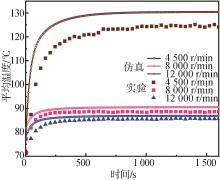
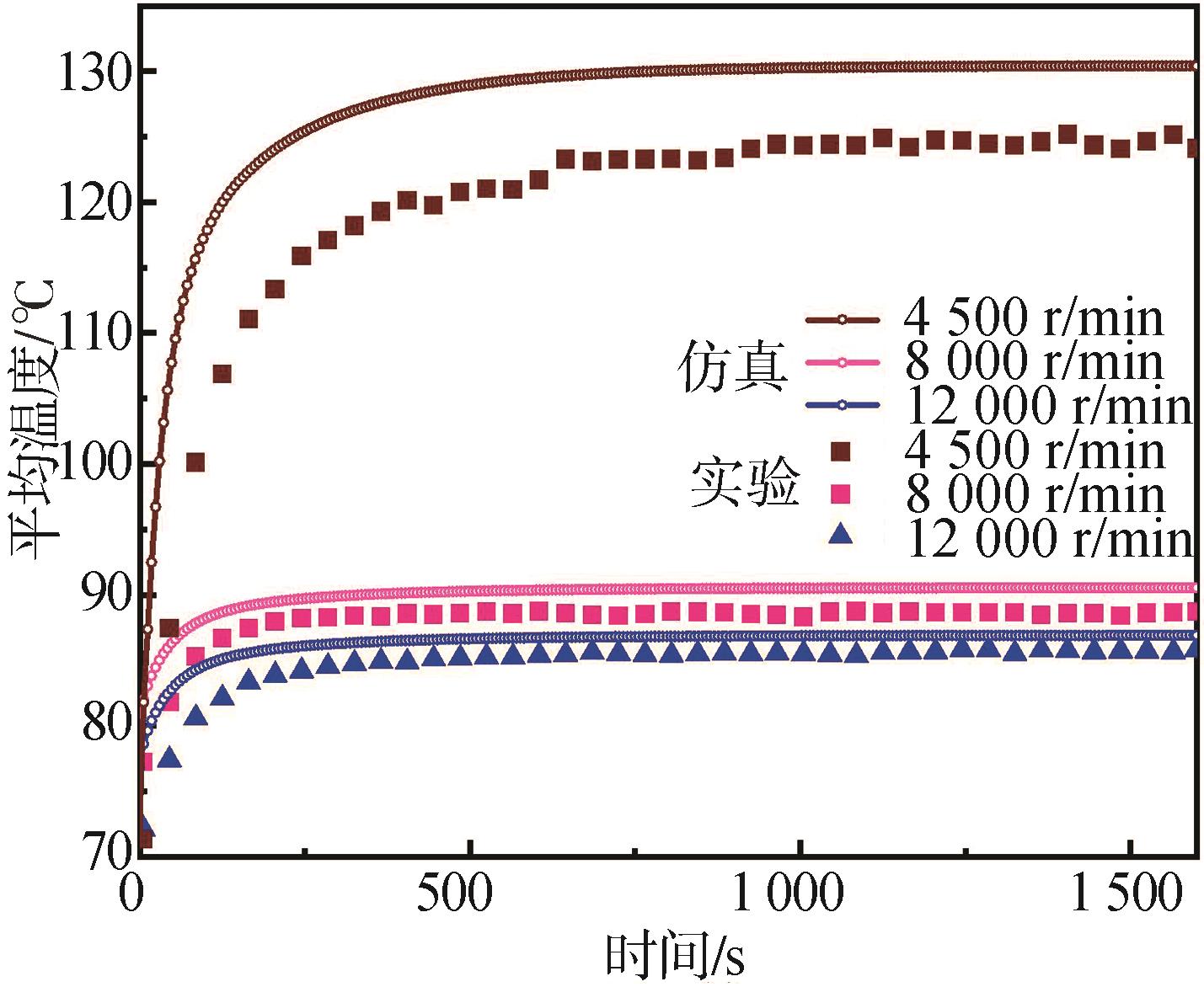
"
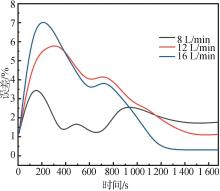
"
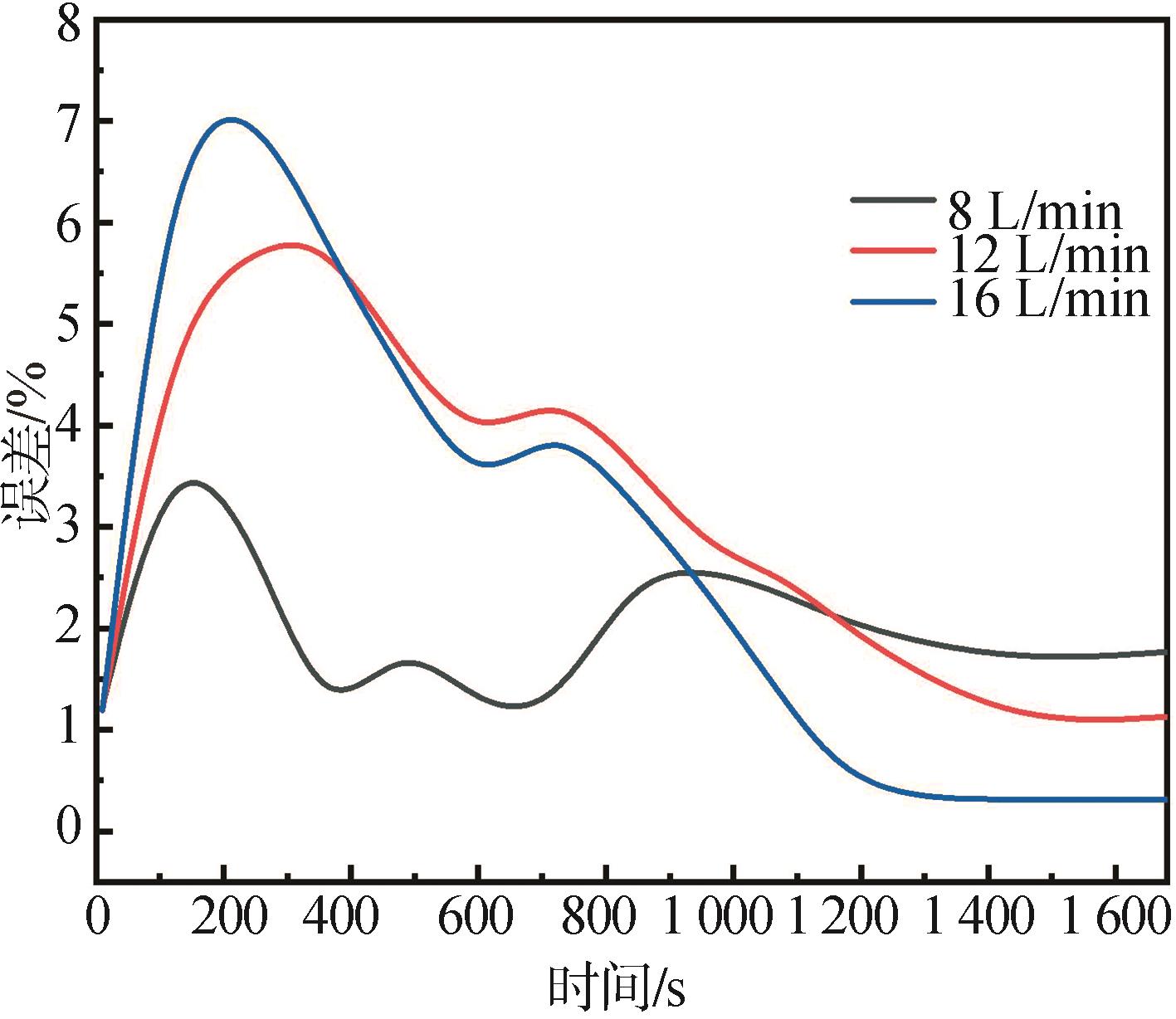
"
"
"
"
"
"
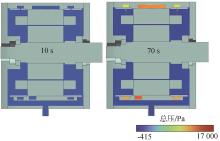
"
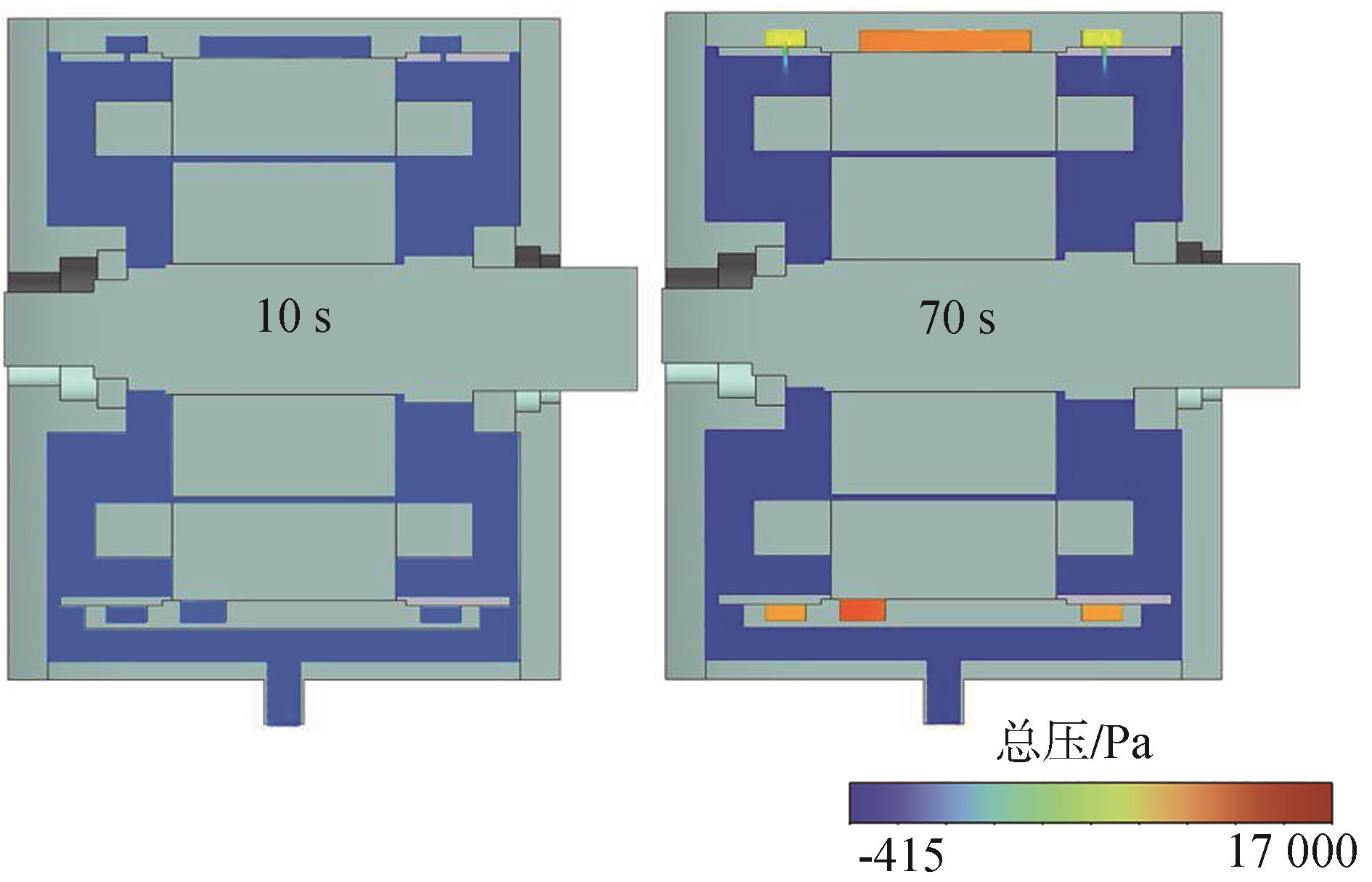
"
| 测量参数 | 10 s | 70 s | 120 s | 400 s |
|---|---|---|---|---|
| 最大压力/Pa | 3 349.8 | 23 120.8 | 23 751.2 | 24 017.3 |
| 平均压力/Pa | 993.4 | 1 343.8 | 2 579.2 | 2 759.9 |
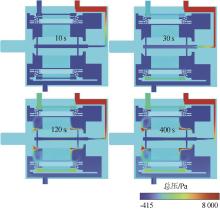
"
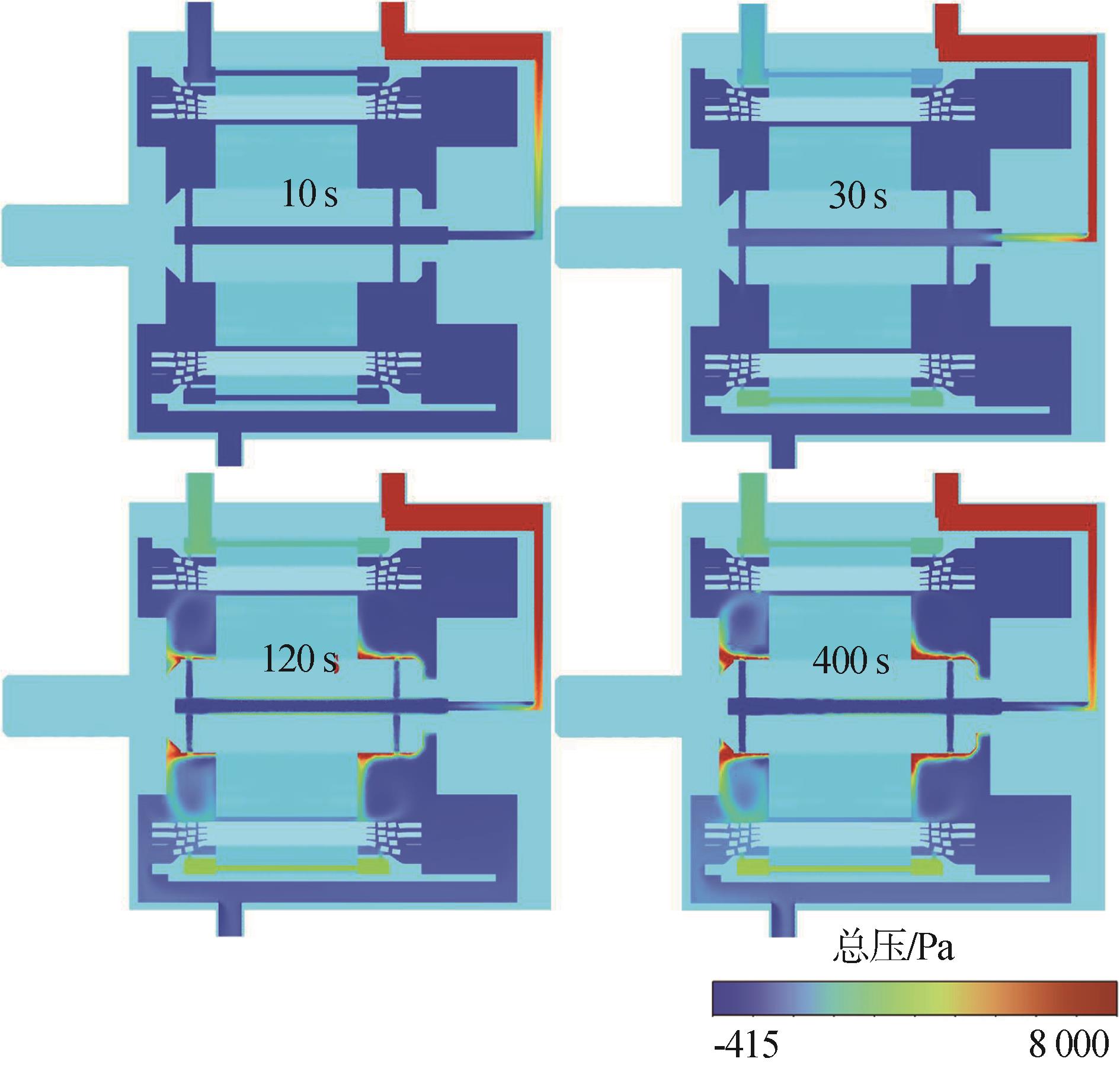
"
| 测量参数 | 10 s | 70 s | 120 s | 400 s |
|---|---|---|---|---|
| 最大压力/Pa | 10 624.6 | 16 534.9 | 18 955.8 | 35 406.4 |
| 平均压力/Pa | 332.7 | 786.2 | 807.2 | 772.9 |
"
"
"
"
| 部件 | 10 s | 70 s | 120 s | 400 s |
|---|---|---|---|---|
| 绕组 | 3.22 | 8.20 | 4.47 | 3.28 |
| 定子 | 4.31 | 6.29 | 5.18 | 4.91 |
| 转子 | 0.04 | 0.30 | 0.08 | 0.01 |
| 转轴 | 0.06 | 1.33 | 0.41 | 0.05 |
"
| 部件 | 10 s | 70 s | 120 s | 400 s |
|---|---|---|---|---|
| 绕组 | 0.72 | 0.85 | 6.79 | 6.39 |
| 定子 | 3.58 | 0.31 | 1.92 | 1.81 |
| 转子 | 2.20 | 1.34 | 16.10 | 16.32 |
| 转轴 | 5.60 | 5.78 | 74.24 | 74.21 |
"
"
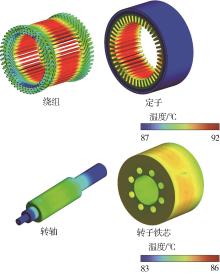
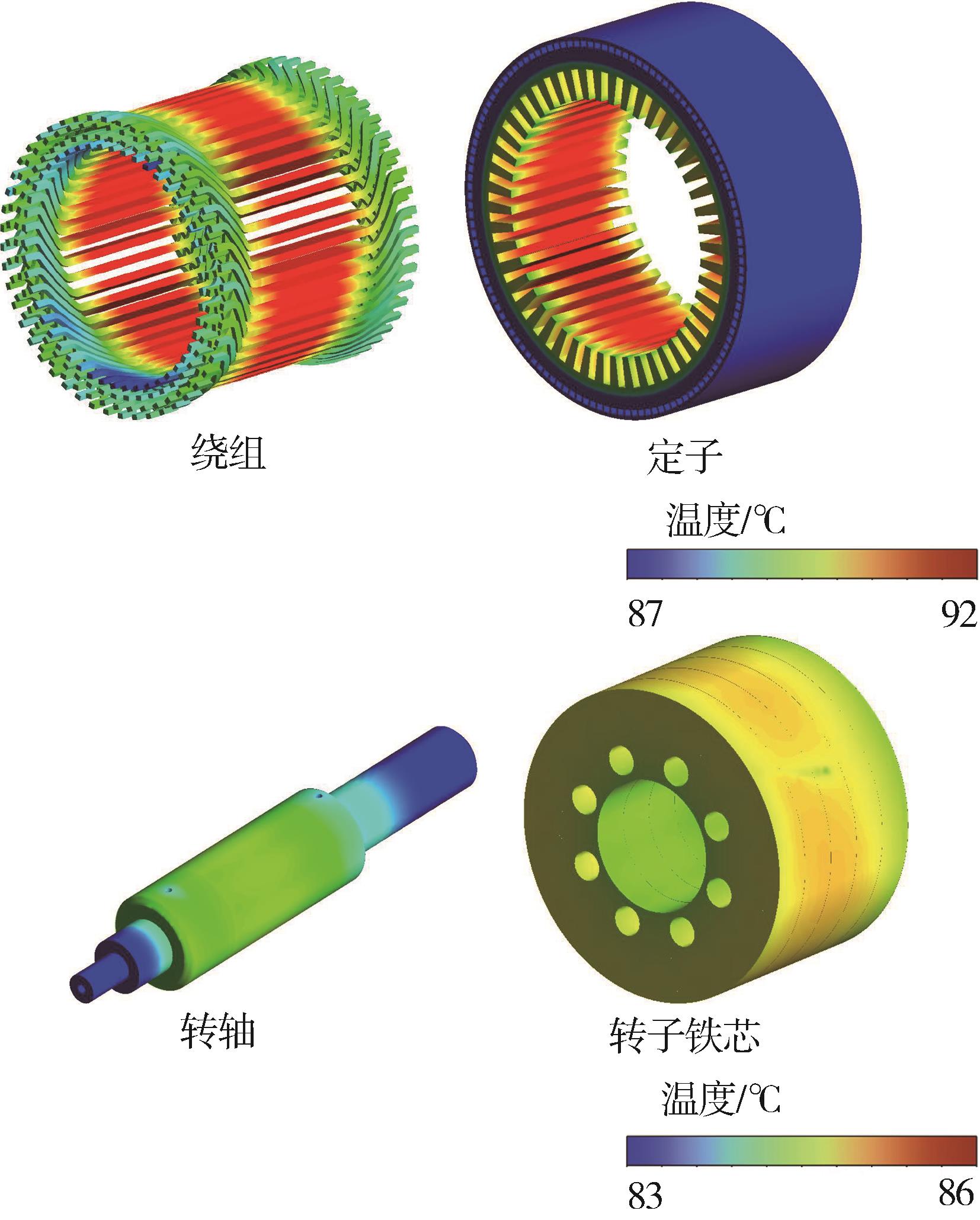
| 部件 | 最高温度/℃ | 平均温度/℃ |
|---|---|---|
| 绕组 | 98.0 | 88.1 |
| 定子 | 93.8 | 82.3 |
| 转子铁芯 | 74.2 | 72.6 |
| 转轴 | 72.8 | 71.7 |
"
"
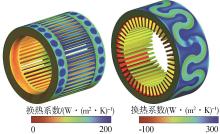
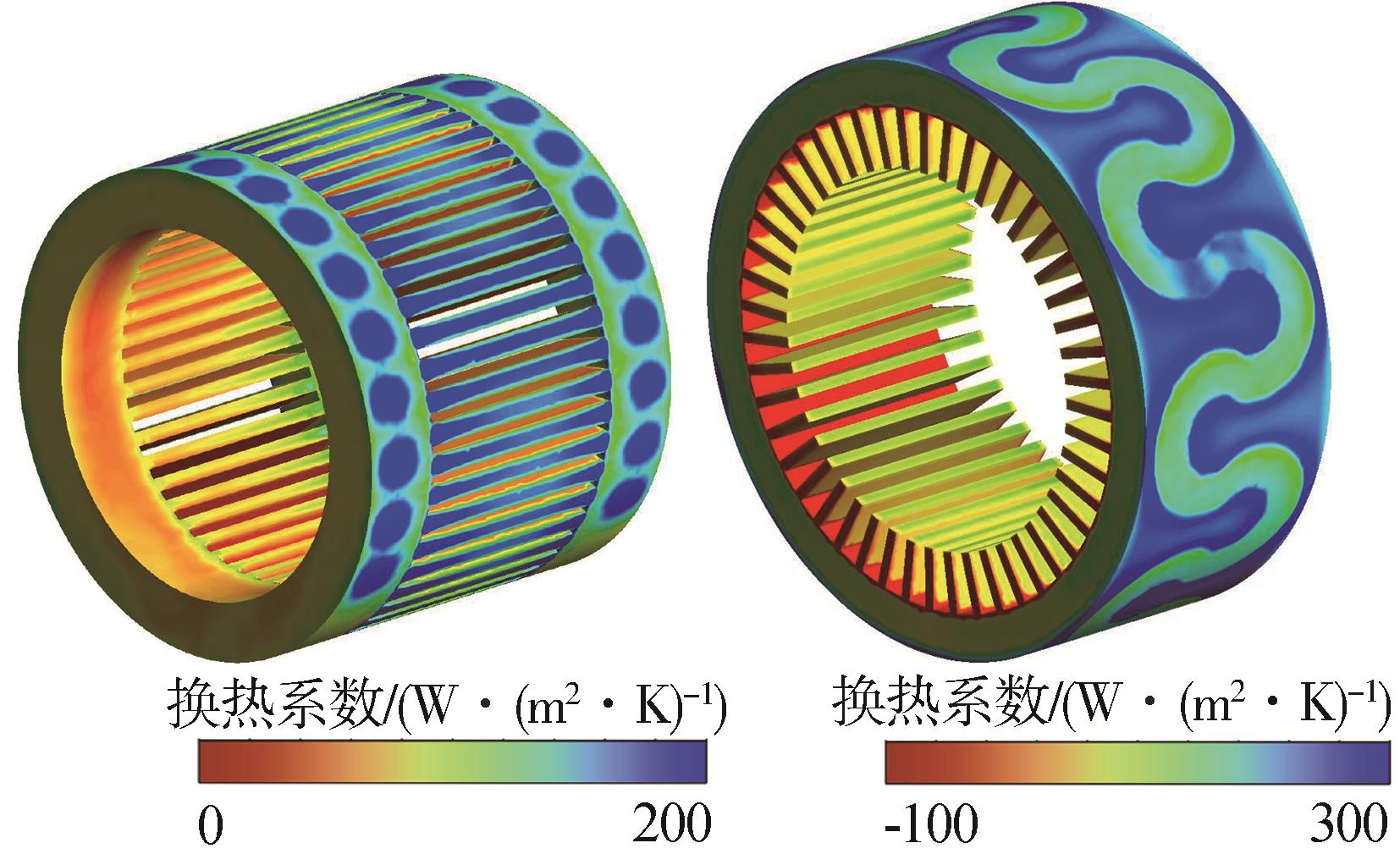
| 部件 | 最高温度/℃ | 平均温度/℃ |
|---|---|---|
| 绕组 | 93.0 | 89.6 |
| 定子 | 92.5 | 87.7 |
| 转子铁芯 | 85.5 | 85.1 |
| 转轴 | 84.7 | 83.6 |
"
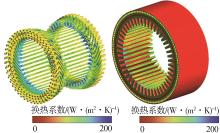
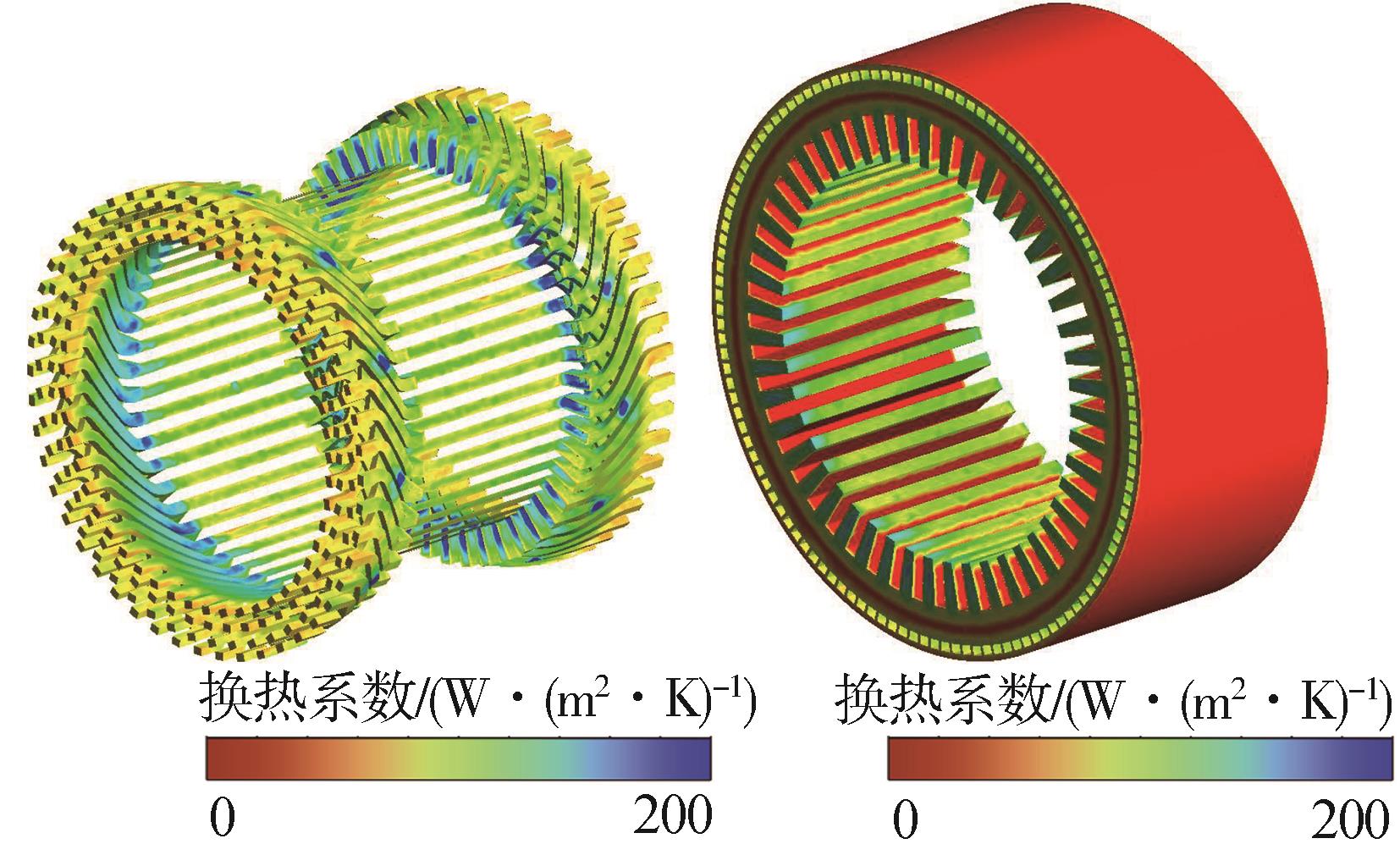
"
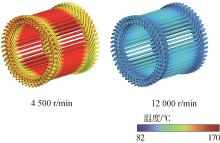
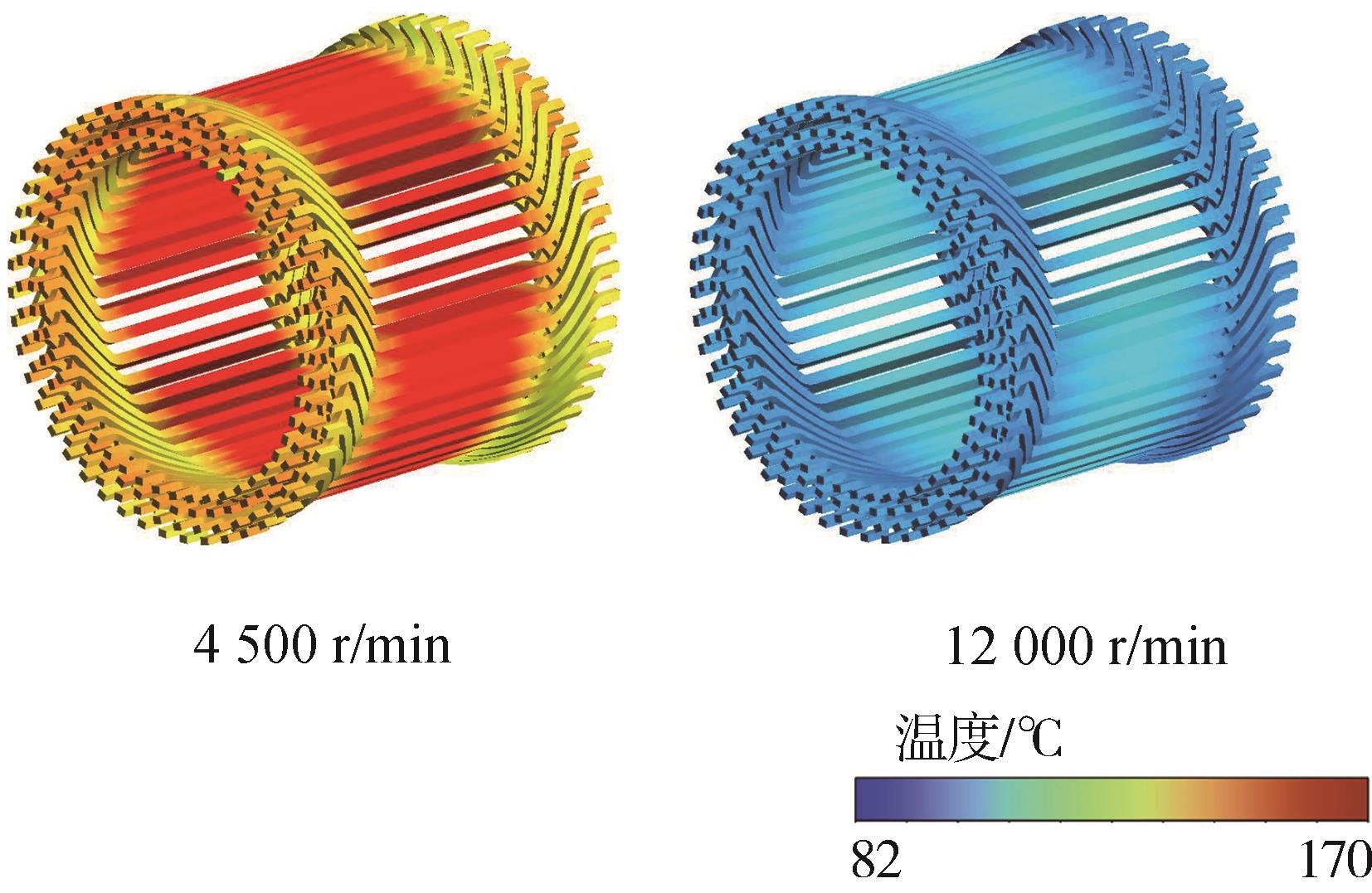
"
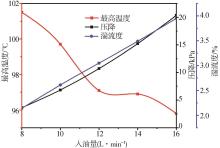
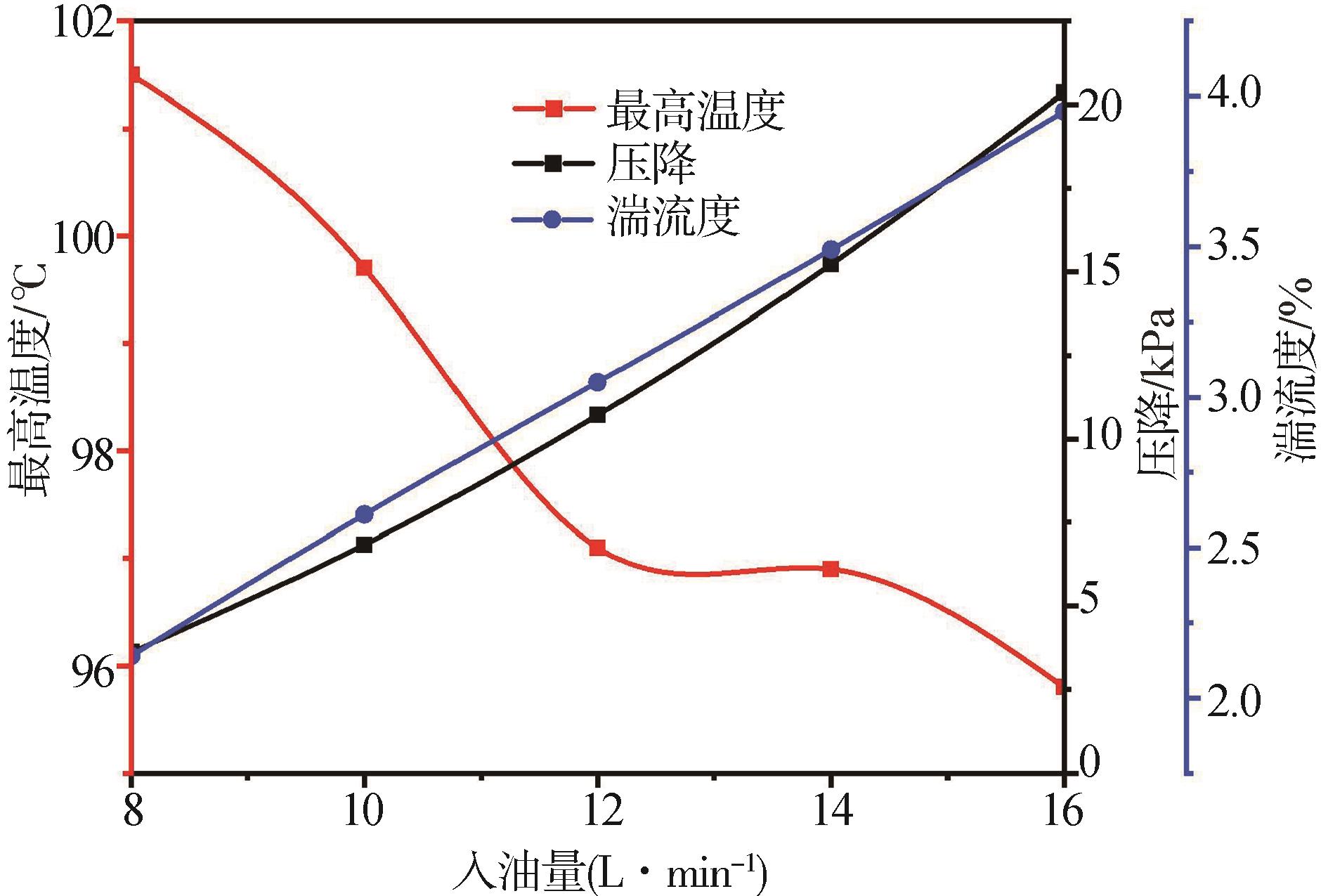
"
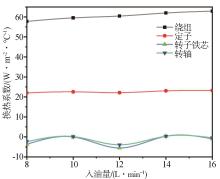
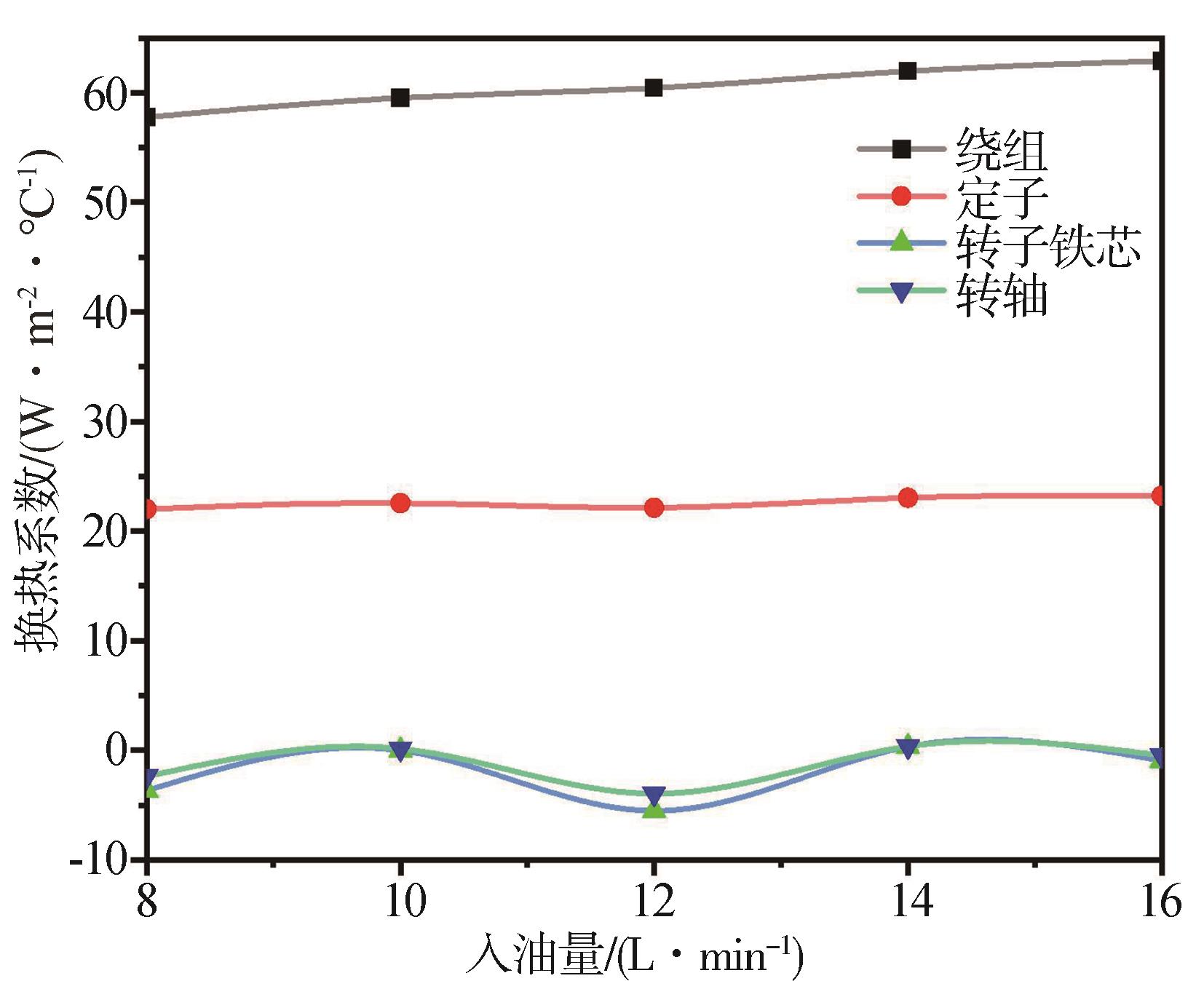
"
| [1] | CARRIERO A, LOCATELLI M, RAMAKRISHNAN K, et al. A review of the state of the art of electric traction motors cooling techniques [C]. SAE Paper 2018 -01-0057. |
| [2] | GAI Y, KIMIABEIGI M, CHONG Y C, et al. Cooling of automotive traction motors: schemes, examples, and computation methods [J]. IEEE Transactions on Industrial Electronics, 2019, 66(3): 1681-1692. |
| [3] | GUO F, ZHANG C. Oil-cooling method of the permanent magnet synchronous motor for electric vehicle[J]. Energies, 2019, 12(15). |
| [4] | PARK M H, KIM S C. Development and validation of lumped parameter thermal network model on rotational oil spray cooled motor for electric vehicles[J]. Applied Thermal Engineering, 2023, 225. |
| [5] | WANG R, XIE P, HE M. Oil-immersed oil cooling motor for electric automobile, has sealing filling layer whose two ends are extended towards same side end cover direction, and cavity formed between end covers and inner surface of shell and connected with oil groove:CN211377756-U [P/OL]. 2020-08-28. |
| [6] | WANG Q, WEI Y. Cooling system of motor assembly for hybrid electric vehicle, has oil cooler that is connected with oil guide pipe and is located between spraying component and oil pump:CN214888767-U [P/OL]. 2021-11-26. |
| [7] | SRINIVASAN C, YANG X, SCHLAUTMAN J, et al. Conjugate heat transfer cfd analysis of an oil cooled automotive electrical motor [J]. SAE International Journal of Advances and Current Practices in Mobility,2020,2(4):1741-1753. |
| [8] | BEDKOWSKI B, DUKALSKI P, JAREK T, et al. The efficiency analysis of various structural solutions of the wheel motor cooling systems [C]. 2018 XIII International Conference on Electrical Machines (ICEM), 2018: 995-1000. |
| [9] | DERISZADEH A, DE MONTE F, VILLANI M, et al. Numerical thermal performance investigation of an electric motor passive cooling system employing phase change materials [C]. Proceedings of the Asme 2021 Heat Transfer Summer Conference (HT2021), 2021. |
| [10] | 杨悦思. 新能源汽车驱动电机油冷系统设计研究[J]. 专用汽车, 2024 (2): 33-36. |
| YANG Y S. Research on the design of oil cooling system for electric drive motors of new energy vehicles[J]. Special Purpose Vehicle, 2024 (2): 33-36. | |
| [11] | 刘奕新, 张志军. 油冷电机磁热耦合仿真研究[J]. 汽车技术, 2022 (11): 41-46. |
| LIU Y X, ZHANG Z J. Simulative research on magneto thermal coupling of oil-cooled [J]. Automobile Technology, 2022 (11): 41-46. | |
| [12] | MIZUTANI R, OHASHI Y, OKUMURA N, et al. Superconducting motor mounted in electric vehicle, has coil whose end portion |
| is located in axial direction of stator and is cooled by cooling unit of several refrigerators:JP2011244535-A [P/OL]. 2011-12-01. | |
| [13] | CAMILLERI R, HOWEY D A, MCCULLOCH M D. Predicting the temperature and flow distribution in a direct oil-cooled electrical machine with segmented stator [J]. IEEE Transactions on Industrial Electronics, 2016, 63(1): 82-91. |
| [14] | 段家超. 新能源汽车驱动电机油冷系统设计与性能研究 [D]. 广州:华南理工大学, 2021. |
| DUAN J C. Design and performance research on oil cooling systemof new energy vehicle drive motor [D].Guangzhou: South China University of Technology, 2021. |
| [1] | Lingchen Kong,Xiaolei Yuan,Xuan Zhao,Qiang Yu,Chenyu Zhou,Rong Huang. A Vibration Transfer Path Analysis Method Based on Entropy Singular Value Decomposition [J]. Automotive Engineering, 2025, 47(9): 1742-1751. |
| [2] | Yang Yang,Zhi Zhang,Bo Xu,Yang Dong. Research on the DDDQ Magnetic Coupled Structure of the Wireless Charging System for Electric Vehicles [J]. Automotive Engineering, 2025, 47(6): 1007-1021. |
| [3] | Jie Hu,Haojie Wang,Min Wei,Zhihong Wang,Lin Chen,Wentao Huang,Hanrui Kang. A TCN-LSTM Model-Based Approach for Real Vehicle Battery Health State Evaluation [J]. Automotive Engineering, 2025, 47(6): 1060-1071. |
| [4] | Xiang Chen,Liping He,Yongkun Xiao,Duanmao Chen,Yaodong Li. Innovative Liquid Cooling Structure and Thermal Optimization for High-Energy Lithium Battery Modules [J]. Automotive Engineering, 2025, 47(6): 1086-1094. |
| [5] | Jun Wang,Chenghao Ma,Zongxuan Shen,Bobin Xing,Yong Xia. Virtual Simulation Research on Crash Safety of Electric Vehicles Under Side Pole Impact [J]. Automotive Engineering, 2025, 47(6): 1095-1102. |
| [6] | Qianwen Zhang,Lei Xu,Qingyang Wang,Shengjin Xu. Dynamic Effect of Underbody Flow Separation on Aerodynamic Drag in Electric Vehicles [J]. Automotive Engineering, 2025, 47(5): 910-919. |
| [7] | Yansong Lu,Chong Zhu,Xi Zhang. A Lumped Parameter Model of Circulating Cooling Oil Temperature for Automotive High-Speed Motor [J]. Automotive Engineering, 2025, 47(5): 920-930. |
| [8] | Yi Luo,Wenbin Ma,Ling Su,Yueqiao Liu,Bo Xiao. Research on the Performance of an Integrated Thermal Management System for Electric Vehicles Based on R290 Refrigerant [J]. Automotive Engineering, 2025, 47(5): 931-939. |
| [9] | Shu Wang,Qi Han,Xuan Zhao,Penghui Xie. Predictive Energy Management Strategy of Plug-in Hybrid Electric Vehicle with Computer Vision [J]. Automotive Engineering, 2025, 47(4): 625-635. |
| [10] | Xiaoting Huang,Haibiao Zhang,Changyu Li,Hui Lü,Wenbin Shangguan. Multi-output Sensitivity Analysis for the Powertrain Mounting System of Electric Vehicles [J]. Automotive Engineering, 2025, 47(4): 746-754. |
| [11] | Zichen Zheng,Shu Wang,Xuan Zhao,Zhaoke Li. Integrated Control of Distributed Drive Electric Vehicle AFS/DYC Based on Hybrid Model Predictive Control [J]. Automotive Engineering, 2025, 47(3): 470-480. |
| [12] | Qin Li,Zhuang Li,Jianming Tang,Yong Wang,Boyuan Zhang,Deqiang He. Multi-objective Torque Distribution Strategy for Distributed Drive Electric Vehicles [J]. Automotive Engineering, 2025, 47(3): 489-498. |
| [13] | Chongguang Zhou,Chongxiang Mo. Design of Vehicle Anti Jerk Control on Electric Motor Torque Near Zero [J]. Automotive Engineering, 2025, 47(2): 315-325. |
| [14] | Qin Shi,Weilu Hou,Xiaonan Zhang,Weijiao Wu,Zejia He. Electric Vehicle Remaining Range Prediction with a Three-Layer Weighted Stacking Model [J]. Automotive Engineering, 2025, 47(1): 107-116. |
| [15] | Hailong Cui,Bing Du,Xiudong Huang,Fenghua Liu,Xuedong Liu,Maowei Zhou. Efficiency Optimization of Iron Core Processing Equipment for Adhesive Motor of Electric Vehicle [J]. Automotive Engineering, 2025, 47(1): 178-186. |
|
||
